


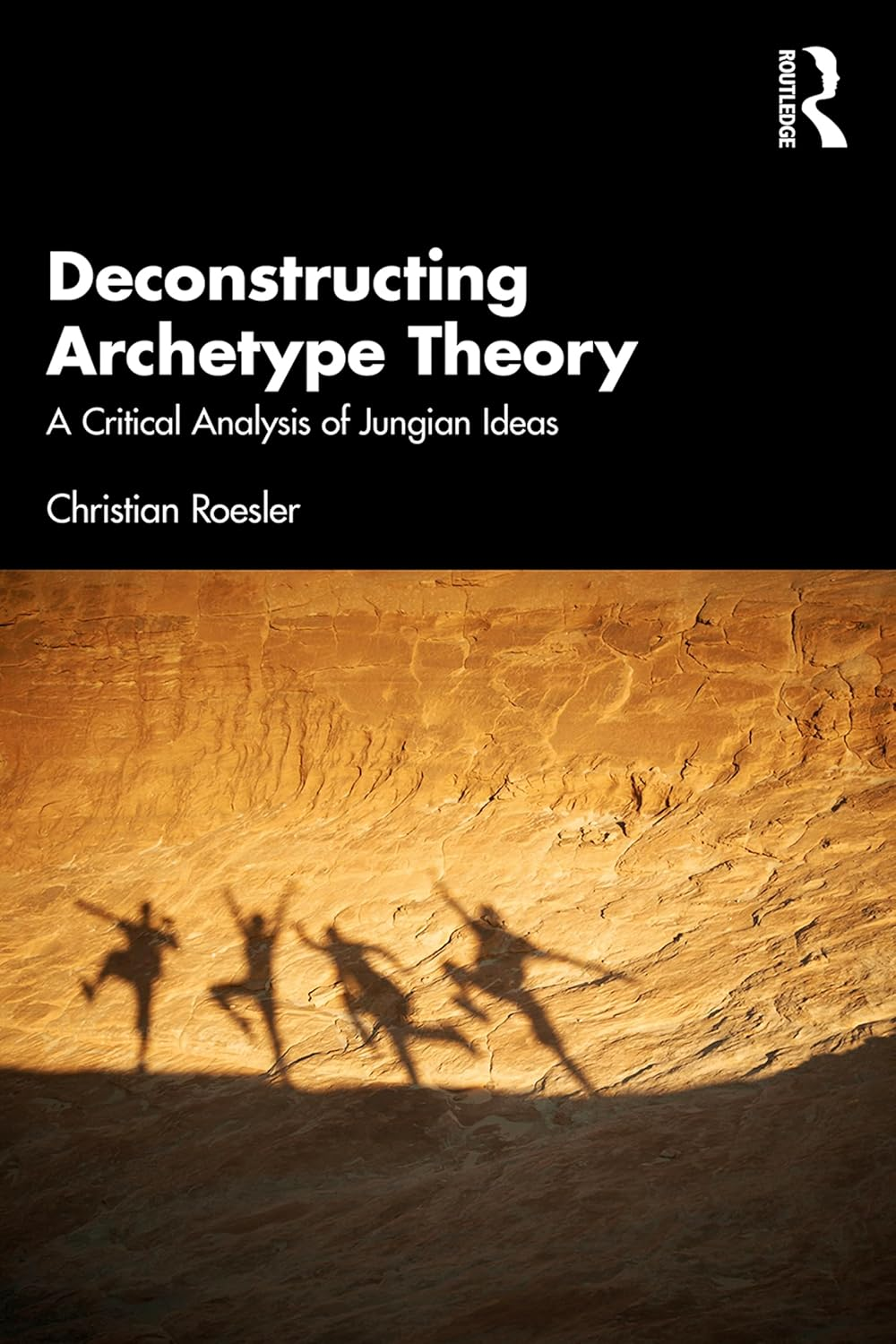
This important book offers a critical and timely reassessment of one of the cornerstones of analytical psychology, Jung’s concept of archetypes.
Exploring not only Jung’s original writings but also the range of interpretations used by Jungian scholars today, the book argues that Jung’s conceptualization of archetype theory is not a single coherent theory; rather, it is four different theories which must be understood separately.
Roesler goes onto deconstruct these four ideas: the biological, the anthropological, the transcendental and the psychological in context with contemporary insights from each of these disciplines.
Also read the article by Christian Roesler on the same topic.
A thorough analysis of the state of knowledge in the respective disciplines (i.e. biology, anthropology, religious and mythological studies) makes clear that the claims archetype theory makes in these fields have no support and should be given up. Deconstructing Archetype Theory concludes by arguing that a universal process of psychological transformation is the only part of archetype theory which should be maintained, as it provides a map for psychotherapy.
Rigorous and insightful, this is a book that will fascinate scholars and practitioners of analytical psychology, as well as anyone with an interest in Jung’s original work.
Table of contents
Chapter 1: Introduction
In this introductory chapter, the central problem in archetype theory is presented, from which the argumentation in this book starts. Since the original formulation of archetype theory by Jung, the concept has been controversial, containing serious misconceptualizations and contradictions, which have continued in analytical psychology to the present day. Still, there is no consensual definition of what an archetype is and how it comes about in the Jungian school. This state of affairs has been confirmed in an investigation conducted by the author in which experts and scholars of archetype theory have been asked to provide their definition and explanation of archetypes.
Chapter 2: Definitions of “archetype” in AP
In this chapter, an overview of definitions, historical as well as contemporary, of the archetype concept are summarized, as they were presented in the development of analytical psychology after Jung. Together with these definitions, the definitions that were given in the aforementioned survey are summarized. Taken together, this provides proof for the aforementioned insight that there is no consensus definition of the archetype concept in analytical psychology today.
Chapter 3: The theory of archetypes in Jung’s works
As a consequence of the insight that there is no consensus definition of the archetype concept in analytical psychology, in this chapter, a thorough investigation of Jung’s own conceptualizations and explanations regarding the theory of archetypes is presented. It becomes clear that Jung in his definitions combined different lines of argumentation which are at least partly contradictory.
Chapter 4: Problems and criticism
In this chapter, an overview of the history of criticism inside as well as outside of analytical psychology regarding archetype theory is presented. A number of problems inherent to the conceptualizations of archetype theory are described in detail. It becomes clear that already beginning in Jung’s days, serious critiques of his archetype theory have been formulated, which has continued to the present day. The chapter concludes that inherent in archetype theory are four different theories which have to be differentiated and which were confused in Jung’s formulations, which has resulted in the problems pointed out here.
Chapter 5: Biology, genetics and inheritance
In this chapter, the first of the four theories outlined earlier will be discussed, which is the biological line of argumentation, and will be examined with contemporary insights and the state-of-the-art in the respective disciplines. These are behavioural biology, human genetics, evolutionary theory, evolutionary psychology and biological anthropology in general. It concludes that the original argumentations that archetypes are like instincts/patterns of behaviour and that the classical archetypes of analytical psychology (e.g., the anima) cannot be thought of to be transmitted via genetical pathways.
Chapter 6: Anthropology
Jung’s theory around archetypes contains ideas from and references to the field of anthropology, specifically, very general and far-reaching assumptions regarding human universals that can be found in peoples from all over the world and from different epochs. He claims that there are similarities to be found cross-culturally in social rules and patterns, cultural habits and symbols/images, religious beliefs and ideas, mythological motifs and narratives, etc. These claims are confronted with the state-of-the-art in anthropology with a special focus on the search for human universals.
Chapter 7: Religion
Jung’s ideas about universalities and cross-cultural similarities also refer to the field of religion, claiming that all the religions of the world are emanating from archetypes, and thus, at the core of all of them, there is something like a primal religion. These claims are confronted with the state-of-the-art in religious studies, showing that there is absolutely no evidence for these ideas.
Chapter 8: Prehistory
In the analysis of Jung’s statements and definitions around the concept of archetypes, a basic element was identified: the idea that archetypes have developed in the prehistory of humans as a “precipitation of experiences” of early men. In this chapter, the state-of-the-art in palaeoanthropology is presented, with a special focus on the so-called Out-of-Africa theory. These insights make clear that cross-cultural similarities, if they are to be found, can well be explained by physical contact, migration and cultural exchange in prehistoric times.
Chapter 9: Mythology
This chapter focuses on the striking similarities found in mythologies from all over the world and the respective research in comparative mythology. Based on the insights that were presented in the chapter on palaeoanthropology, the theory of Michael Witzel is presented which explains the similarities and differences in cosmologies from all over the world on the migration of early humans across the continents. This makes clear that isolationist argumentations cannot be maintained today.
Chapter 10: Conclusion
The core theory – a theory of psychological transformation
In this final chapter, a conclusion is drawn based on the argumentations presented earlier. The core of archetype theory is identified as being a theory of psychological transformation, which takes place in the course of psychotherapy and has a universal shape. It is argued that based on the misconceptions presented earlier, the future archetype theory should be reduced to this core theory, and it should be investigated thoroughly in a program of open-minded research.
Publisher: Routledge, 2023, pp. 280, ISBN 978-1032390499
Christian Roesler, PhD
 Christian Roesler is a Jungian psychoanalyst (IAAP) in private practice and a training analyst for the C.G. Jung-Institutes in Stuttgart and Zurich. He is also a professor of clinical psychology at the Catholic University Freiburg (Germany), a lecturer in analytical psychology at the University of Basel (Switzerland), and an associate Professor for Psychotherapy Science at the Sigmund Freud Private University (Austria).
His recent books, all published by Routledge, are:
- C. G. Jung’s archetype concept: Theory, research and applications (2021).
- Deconstructing archetype theory: A critical analysis of Jungian ideas (2023)
- Dreams and dream interpretation: A contemporary introduction (2025)
Learn more
- Critique of archetype theory: yesterday and today—an article by Christian Roesler