


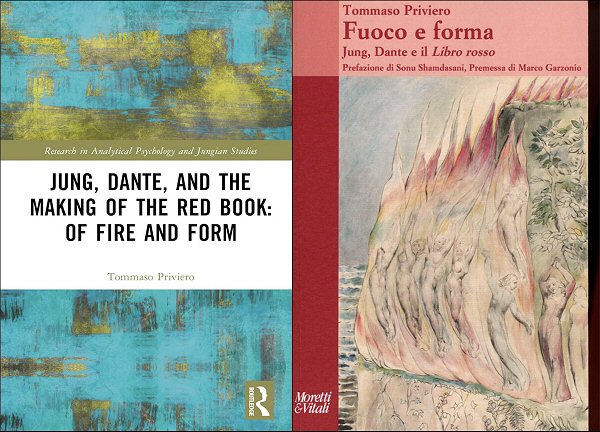
Rather than offering a Jungian interpretation of Dante, this book reverses the perspective, suggesting a fresh Dantesque reading of Jung, starting from the distinctively Dantesque idiom of the Red Book. This scholarly work unravels this encounter and suggests a new way to explore the relations between analytical psychology and what Jung referred to as “visionary literature”.
Also read Tommaso Priviero’s article on Dante and love in C.G. Jung’s Red Book.
On this page
- Reflective essay | Tommaso Priviero
with an invitation to the Fire Seminars - About the book
- Endorsements
Sonu Shamdasani & “Eugenio Montale Fuori di Casa Award” - Table of contents
Reflective essay
Tommaso Priviero
While growing up in Italy, an encounter with Dante Alighieri’s Commedia is something that cannot be escaped.
This work, which recounts Dante’s journey through hell and back to find his beloved Beatrice, has been transmitted, generation after generation, as the most iconic work of Italian and possibly European literature. It is an intrinsic part of the Italian language and collective imagination.
For many students, reading Dante’s Commedia is more an obligation than an enjoyable experience. The burden of the monumental authority of the text and centuries of critical commentaries suffocate creativity. By the time of adulthood, it becomes hard to look at it with fresh eyes as a living text.
Ironically, my own rediscovery of the Commedia happened far away from Italy, when in my late 20s, I found myself living in London, as one of many Italian migrants.
I was in the UCL science library on a cold November evening when I first stumbled upon the enormous red manuscript of C.G. Jung’s Red Book. Its pages were filled with mysterious images and a hypnotic narrative. I discovered that this was the “most difficult” and most important experiment of Jung’s life, the record of a visionary experience which formed the “esoteric” core of his entire psychological system, known as analytical psychology.
What struck me almost immediately was how deeply the Red Book resembled Dante’s journey.
It too began with a man mid-way through his life who found himself bewildered in a wasteland, and went on searching for his “soul”, “like a tired wanderer who had sought nothing in the world apart from her” (Jung, 2009). This time, the journey was not a poetic fiction but a lived psychological ordeal.
Mesmerised, I wrote a long letter to Sonu Shamdasani, the editor of Jung’s Red Book (posthumously published in 2009) and professor of History of Psychology at UCL, proposing a doctoral project on Jung and Dante. To my surprise, while savoring together an Indian lunch in Drummond Street, he agreed to supervise the project. That meeting opened a path I have followed ever since.
Jung did not read Dante as a cultural monument of the past. For him, the Commedia was the work of a visionary who undertook a process of profound psychological transformation.
The compelling power and deeper meaning of the work, he wrote, “do not lie in the historical or mythical material, but in the visionary experience it serves to express” (Jung, 1922).
He saw the Commedia as a “meditation book” and an “excellent introduction” to the psychoanalytic work undertaken in the consulting room with patients.
Others, too, sensed this visionary core. Ezra Pound, for example, believed that the many personifications that Dante encountered in his adventures were certainly “real and not artificial” (Pound, 1910), as the product of a mind attuned to extra-ordinary states of consciousness.
Osip Mandelstam—who used to carry 1kg of bread and Dante’s collected works in his luggage while escaping persecution in Soviet Russia—predicted that one day, when the natural sciences would be able to study the human ability to “think in images”, a deeper dimension of the Commedia would be finally understood (Mandelstam, 1933).
But Jung’s encounter with Dante contained an additional urgency.
During the years he studied the Commedia, Jung himself was immersed in his own “season in hell”, a “confrontation with the unconscious”, as he later called it, which produced the Red Book. He read Dante, not as a scholar, but as a companion.
Two women were indispensable to Jung during this period: his wife and lifelong companion Emma Rauschenbach and Toni Wolff, his collaborator and soul-mate. Toni Wolff was the only person allowed to annotate the notebooks which documented Jung’s experiment. Meaningfully, among her rare notes is a reference to love from Dante’s inscription on the gates of hell, where his journey began.
My own re-encounter with Dante through Jung became the inspiration of my book, Of Fire and Form: Jung, Dante, and the Making of the Red Book (Routledge, 2023, with a Preface by Sonu Shamdasani), which documents the historical, textual and symbolical similarities between the Red Book and the Commedia.
The symbolism of “fire” is central to both works. For Jung, fire was the energy of the psychic material that he engaged with for more than sixteen years. It was the fire of passions, an equally vital and dangerous force, which required a “form”, a vessel capable of harnessing and transforming them, a role which the Red Book fulfilled.
Today, a large number of Jungian training organisations exist in the world. Concepts such as “complexes”, “archetypes”, “collective unconscious”, “psychological types”, have entered popular usage. An increasing number of people have become attracted to Jung’s psychology.
The Fire Seminars
More than a decade after the publication of the Red Book, Jungian studies are undergoing a revolution. The Jung revealed in the Red Book is not the Jung that had been known and frequently misunderstood through decades of secondary interpretations. The author of the Red Book is a more fiery and contemporary Jung who still awaits proper study.
For this reason, two years after the publication of Jung, Dante, and the Making of the Red Book, I felt called to bring this research into a living, collective setting. The result is a ten-session seminar series that will run monthly from January to November 2026.
The intention of this seminar series is to create a shared space for reflection and inquiry around the many thematic areas which Jung’s reading of Dante stimulates, with the aim of forming a proper “group mind” to work on this process.
The making of the Red Book, Dante’s presence in Jung’s works, the relations between analytical psychology and poetry, the archetypal myth of the “descent” into the unconscious, Jung’s “science of visions”, animal symbolism, the erotic and the spiritual, are only a few of the themes which this seminar series will address.
For those who would like more information, consider enrolling in the online seminar series starting on 24 January 2026: Jung, Dante, and the Making of the Red Book: The Fire Seminars.
About the book
In this book Tommaso Priviero traces C.G. Jung’s encounter and lifelong confrontation with the Italian poet Dante Alighieri. Dante’s Commedia, one of the defining works of European literature, recounts the protagonist’s visionary journey into hell and back in order to meet his beloved Beatrice again.
For Jung, the Commedia was less a literary work than a first-hand account of a profound existential transformation. As Jung entered his own “season in hell” and wrote about it in the notebooks that formed the Red Book, the Commedia offered him guidance and inspiration.
Jung included quotations entries from Dante’s poem and regarded the latter as a “meditation book” enriched with archetypal symbolism. The story of the Commedia intersected with his own explorations, at historical, psychological, and symbolical levels.
Rather than offering a Jungian interpretation of Dante, Priviero’s book reverses the perspective, suggesting a fresh Dantesque reading of Jung, starting from the distinctively Dantesque idiom of the Red Book. This scholarly work unravels this encounter and suggests a new way to explore the relations between analytical psychology and what Jung referred to as “visionary literature”.
Endorsements
From the preface by Sonu Shamdasani
Jung, Dante, and the Making of the Red Book: Of Fire and Form can itself be principally read in two ways. On the historiographical level, it presents the first detailed (and long overdue) study of the relationship between Jung and Dante. […]
On the symbolical level, it stages an encounter between the images and figures of the Commedia and Liber Novus, tracing their intertextual correspondences and divergences. While the first level traced and reconstructed a tradition of esoteric reading, the second level performatively enacts it, through locating intersections of symbolic forms and utilising these as keys to the existential states linked to them (Sonu Shamdasani, “Preface”).
From the « Eugenio Montale Fuori di Casa Award”
This book, which is the result of original, extensively documented research conducted with passion, shows how reading Dante provied inspiration and guidance for Jung in the dramatic confrontation that the founder of Analytical Psychology undertook with his personal unconscious and with the collective unconscious during an epochal transition: the years when Europe was entering the vortex of destruction of the First World War.
Priviero reveals the exemplary nature and absolute modernity of the encounter between Jung and Dante, illustrating the symbolism of natural and psychic places (forest, desert, mountain, frightening beasts), existential trials (journeys, encounters, descents into the circles of hell, ascents), the need for guides (Virgil and Philemon), the inner transformation made possible by the integration of the feminine (Beatrice, the ‘woman of the mind’ and heart), and the love that moves everything.
A style of writing marked by essentiality engages the reader of Jung, Dante, and the Making of the Red Book to the point of imagining that they themselves can undertake the inner journey of the psychologist and poet (Adriana Beverini and Marco Garzonio, “Eugenio Montale Fuori di Casa Award”, 2025 Winner).
Table of contents
 Tommaso Priviero, PhD
Tommaso Priviero is an analytical psychologist and historian of psychology based in London. He received his PhD from University College London (UCL) and currently holds a Leverhulme Early Career Fellowship at Queen Mary University of London (QMUL).
His book Of Fire and Form: Jung, Dante, and the Making of the Red Book (Routledge, 2023; with a preface by Sonu Shamdasani) received the prestigious 2025 “Eugenio Montale Fuori di Casa” award.
He is a registered member of the Society of Analytical Psychology (SAP), the British Psychoanalytic Council (BPC) and the International Association for Analytical Psychology (IAAP).
Learn more
- Dante and love in C.G. Jung’s Red Book—an article by Tommaso Priviero
- Jung, Dante, and the making of the Red Book—a reflective autobiographical essay by Tommaso Priviero