In this deeply nuanced article, Rachel Huber explores the intersections of symbolic disciplines and analytical psychology within therapy. She positions Jungian psychology as a clearing in the heart of this forest of disciplines: a science of lived symbols. It offers a clinical hermeneutics for individual transformation, adding a crucial fourth dimension: lived experience and forward-looking perspective.
While acknowledging the value of amplification, Huber cautions against rigid symbolic maps, emphasizing that the map should illuminate and protect the traveler without replacing the journey.
French version of this article
On this page
- The quest for meaning and the house of images
- Mapping the disciplines of the symbol
[symbolism, semiology, iconography and iconology, symbology]
- The Jungian perspective: the symbol as a living force
[beyond the sign, transcendent function, archetypes and archetypal images, alchemy and the coniunctio oppositorum, active imagination]
- Dialogue between semiotics and analytical psychology
[convergences and differences, case vignette of insomnia]
- Dialogue between iconology and analytical psychology
[Panofsky’s three levels and the Jungian fourth dimension, case vignette of emerging voice, role of the body]
- Dialogue between comparative symbology and analytical psychology
[symbolic maps and the risk of fixation, case vignette of a contemporary Artemis]
- Clinical hermeneutics of the symbol
The quest for meaning and the house of images
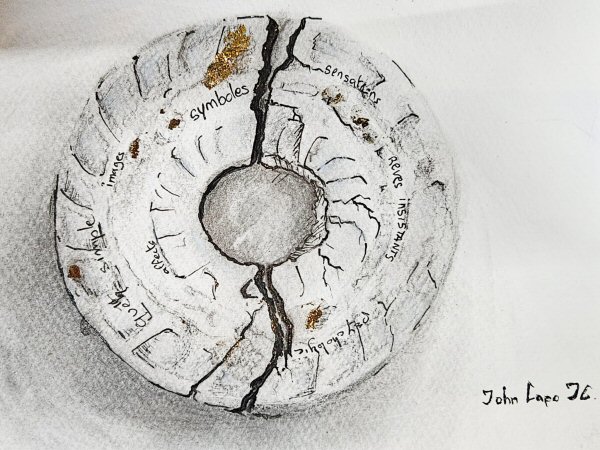
Every day, I am witness to a quest that is at once simple and immense. Women and men cross the threshold of the consulting room carrying questions that go far beyond a simple diagnosis. They bring fragments of stories, heavy silences, and persistent dreams that continue to speak long after the day has begun. My work is to help listen to the language of the soul, as I continue to call it: a language that seeks to express itself. This language most often appears in the form of images, sensations, and affects, in a single word: symbols.
Yet the study of symbols does not only belong to psychology. It sits at a crossroads where multiple paths intersect. Semiotics offers a rigorous grammar of signs. Iconology provides a proven method for interpreting artistic images. Comparative symbology assembles vast repertoires and highlights enduring anthropological patterns.
Faced with this chorus of knowledge, where does analytical psychology stand? Is it simply one approach among many, a clinical application of broader principles, or does it offer a radically different perspective on the nature and function of the symbol?
It seems to me that analytical psychology is a clearing in the heart of this forest of disciplines. It calls upon them to illuminate the path, then guides them with gratitude back to a more intimate source: that of lived experience. From this perspective, the symbol is no longer an inert object of study, a specimen to classify, or a code to decipher. It becomes a living subject, a breathing force, an energy that guides, an agent of psychic transformation. the methods that honor this vitality require intellectual rigor ,and also, perhaps above all, a form of hospitality of the heart.
Mapping the disciplines of the symbol
Before being able to situate the Jungian perspective, it is useful to outline the territories of neighboring disciplines with which it maintains an ongoing dialogue, characterized by both borrowing and critique.
Symbolism: between inventory of contents and literary movement
The term “symbolism” is polysemous. In its most common and descriptive sense, it refers to the collection of meanings attached to a particular motif. One might speak, for example, of the symbolism of water, fire, or mountain. In this context, the work resembles the compilation of a repertoire of cultural meanings. The word also refers to an artistic and literary movement of the late nineteenth century which, in reaction to naturalism, sought to “clothe the Idea in a perceptible form” (Moréas, 1886).
In an academic context, the work of Gaston Bachelard has profoundly innovated the approach to symbolic content. In La psychanalyse du feu [The psychoanalysis of fire] (1938) and L’eau et les rêves [Water and dreams] (1942), he explores the material imagination of the elements. Bachelard shows how water becomes an inexhaustible reservoir of resonances, from purity to dissolution, how fire generates images of purification and fervor, and how air and earth give rise to distinct poetic regimes.
This phenomenological approach to imagination is valuable for the practice of Jungian amplification. However, it becomes sterile if it leads to fixing a symbol in a definitive equivalence, forgetting that its primary function is to move the psyche rather than to define it.
Semiology: the science of signs and systems
Semiology refers to the general science of signs. Visual semiotics is the branch applied to images, logos, pictograms, photographs, and films. This field draws on two foundational frameworks: the Saussurean and the Peircean models of the sign.
In the European tradition, Ferdinand de Saussure postulates that the linguistic sign is composed of:
- a signifier (the acoustic image);
- a signified (the concept).
The link that unites them is fundamentally arbitrary, and their value is defined by the differences that set them apart from other signs within the system of language. Saussurean semiotics is therefore dyadic and differential.
In the United States, Charles Sanders Peirce developed a triadic and pragmatic theory. The sign, or “representamen”, is “something which stands for something to someone in some respect or capacity” (Peirce, 1978). It involves a triad:
- the sign itself;
- the object to which it refers;
- the interpretant (the effect produced in the mind).
Peirce distinguishes three types of signs according to the nature of their relation to the object:
- the icon (based on resemblance);
- the index (based on physical contiguity, such as smoke for fire);
- the symbol, which relies on convention or law.
Semiotics illuminates with remarkable power the rules governing the formation of meaning in languages, images, rituals, and media. Its strength lies in providing a common grammar for analyzing codes.
From a Jungian perspective, its limitation is to reduce the symbol to a mere element of code. The living symbol, as C.G. Jung understands it, exceeds any fixed equivalence. It is not arbitrary but charged with an inner necessity. It is not merely conventional but carries a numinous energy.
Iconography and iconology: seeing, naming, interpreting
Developed for art history, iconography and iconology are inseparable from the work of Erwin Panofsky.
Iconography is the descriptive stage that identifies the subjects, motifs, and attributes of an image by referring to literary and cultural sources.
Iconology, on the other hand, seeks to unfold its deeper meaning: the “content”. In Studies in iconology: Humanistic themes in the art of the Renaissance, Panofsky (1939) distinguishes three levels of interpretation:
- Pre-iconographical description, which identifies the pure forms (objects, events) as primary motifs.
- Iconographical analysis, which connects these motifs to conventional themes or concepts. For example: identifying a figure holding a wheel as Saint Catherine.
- Iconological interpretation, which seeks the intrinsic meaning or content by relating the work to its original culture and the artist’s worldview, thus revealing the “basic principles which reveal the fundamental attitude of a nation, a period, a class, a religious or philosophical conviction”.
This method is an extraordinary training for the eye. It resonates with analytical psychology in its rigorous attention to layers of meaning and its rejection of hasty projection. It differs, however, in its center of gravity.
Iconology remains a hermeneutic of external cultural works. Analytical psychology accompanies images that emerge from the deepest reaches of the psyche (dreams, visions, spontaneous drawings, and writing), whose purpose is less aesthetic than vital. Amplification through art history then becomes a way of allowing a personal image to resonate within a universal context.
Symbology: comparing without fixing
Broadly speaking, symbology encompasses comparative approaches that catalog and analyze symbolic motifs across religions, myths, folktales, and rituals. In Le Sacré et le Profane [The Sacred and the Profane] Mircea Eliade (1957) mapped the structures of the sacred, showing how hiérophanies (manifestations of the sacred) organize space (axis mundi) and time.
In Les structures anthropologiques de l’imaginaire [The Anthropological Structures of the Imaginary], Gilbert Durand (1960) proposed a classification of images into two main regimes:
- the diurnal, associated with verticality, light, and heroic symbols;
- the nocturnal, associated with descent, intimacy, and symbols of fusion.
Meanwhile, Georges Dumézil (1958) highlighted the trifunctional structure of sovereignty, war, and production that organizes Indo-European pantheons and myths.
These monumental works help to identify anthropological constants and navigate immense libraries of images. The main risk is fixing meaning in a dictionary-like way, where the serpent “signifies” regeneration or the tower, pride.
Analytical psychology uses these repertoires as one uses a choir to support the voice of a soloist. The choir provides depth and universality, but it must never overwhelm the unique melody and the singular vibration of the voice.
The Jungian perspective: the symbol as a living force
Analytical psychology draws on these disciplines but makes a decisive shift. The symbol is not an object to be interpreted, but a process to be lived. Its nature is not semiotic but energetic and teleological.
Operational definition: beyond the sign
In Jungian psychology, it is valuable to return to the Greek origin of the term. The symbolon designated a token of recognition between two hosts. An object was divided in two, and each person kept a half and passed it on to their descendants. The day these fragments could be reunited, they became proof of lineage and allowed the alliance between families to be renewed.
It is also illuminating to consider the German word Sinnbild, composed of two terms: Sinn, referring to meaning or conscious thought, and Bild, which means image. The symbol thus appears as an “image of meaning”, or a materialized thought.
Whether referring to its Greek origin or to the German term, the symbol always implies a polarity: one part is known and mastered, while the other remains hidden and mysterious, yet necessarily completes the first. The symbol is thus the figure of a divided totality, which can only be revealed by bringing together what is separated.
From the Jungian perspective, a symbol is thus the best possible expression, at any given moment, of a psychic content that remains largely unconscious.
It is radically different from a sign or an allegory. Jung (1921) states this with clarity in Psychological Types:
The concept of a symbol should in my view be strictly distinguished from that of a mere sign. (§ 815)
Every view which interprets the symbolic expression as an analogue or an abbreviated designation for a known thing is semiotic. (§ 816)
Every view which interprets the symbolic expression as the best possible formulation of a relatively unknown thing […] is symbolic. (§ 817)
With Liliane Frey-Rohn, a close collaborator of Jung, we enter more deeply into this definition:
For Jung, a symbol is directed neither at a concrete object nor at a sexual (specifically genital) object. He never limited himself to a concrete or material explanation of the symbol. According to him, doing so would amount to reducing human value to that of pure instinct.
What seems to him of paramount importance in the notion of the symbol is its capacity to transcend opposites and to complete them through images of the individual’s psychic totality. The symbol helps unify nature and spirit, as well as light and darkness. For Jung, the symbol is a paradox: a third notion that stands above the conflict between yes and no within the individual’s mind. [translated from Jung ou la totalité de l’Homme futur “Les symboles et archétypes” 5/8]
A sign refers to something known: a red light means stop. An allegory translates an already conscious idea into an image: peace represented by an olive branch. The symbol, by contrast, opens onto a surplus of meaning. It cannot be exhausted by paraphrase or conceptual translation.
A symbol works upon the psyche, sets it in motion, and transforms the level of consciousness. The fruitful question, then, is not “What does this symbol mean?” but “What does it produce here and now, in this life and in this body?”
The transcendent function: inventing a third term
The transcendent function is the psyche’s natural capacity to generate a third term out of the tension between opposites: consciousness and the unconscious, waking and dreaming, security and freedom, the inner and the outer world, fidelity and novelty. Psychic life is woven from such polarities. When the tension becomes unbearable, the symbol performs this mediation. It does not abolish the tension; it holds it, while at the same time inventing a passage, a bridge.
As Jung writes:
The transcendent function manifests itself as a quality of
conjoined opposites. (Jung, 1916, § 189)
This function has nothing mystical in the vague sense of the term. It designates a dynamic of self-regulation and growth, observable in clinical practice whenever an image, a dream, or a creative act helps one navigate an existential impasse.
Archetypes and archetypal images
Personal symbols that emerge in an individual’s dreams or imagination resonate with universal structures of the human imagination, which C.G. Jung calls archetypes. It is necessary to distinguish the archetype in itself from the archetypal image.
- The archetype in itself is a structuring pattern, an a priori potentiality, not directly representable, belonging to the collective unconscious. It resembles a “template for psychic behavior.”
- The archetypal image, on the other hand, is its concrete and variable manifestation within a culture, a myth, or a dream. The Great Mother, the Divine Child, the Shadow, the Anima and Animus, the Wise Old Man, the Divine Trickster: each of these is a pattern of representation that recurs universally.
The archetype never replaces a person’s singular lived experience; it offers them a form of recognition, a sense of kinship, and a horizon that frees them from pathological isolation.
But if a symbol can touch an individual deeply, it is because it also resonates with something larger: a shared substrate within a human group.
For a symbol to truly live, it cannot be confined to a purely private experience. It must speak both to the singularity of an individual and to the universality of a community, even if only to create resonance. It must therefore be able to grasp what is common within that group. Through its divinatory aspect and its hidden meaning, the symbol vibrates both thought and feeling. Its unique plasticity endows it with forms perceptible to the senses, which stimulate sensation as much as intuition.
Thus, the symbol lives through this dual belonging: it touches the intimate life of an individual while speaking the shared language of humanity. It is precisely this power of resonance, both individual and collective, that led Jung to alchemy: a realm where ancient images, born of matter and fire, become mirrors of a universal inner transformation.
Alchemy and the coniunctio oppositorum
In his search for a historical language to describe the process of individuation, C.G. Jung found in Western alchemy an imaginal laboratory of unparalleled richness. According to historical nomenclatures, the list of operations varies, but here is a representative selection of the main alchemical operations:
- Calcinatio (calcination): reduction of the material to ashes by fire.
- Solutio (dissolution): dissolving the ashes in water.
- Separatio (separation): separation of the dissolved elements.
- Coniunctio (conjunction): reunion of the separated elements.
They serve as figurative representations of the stages of psychic transformation
The heart of this Great Work is the conjunction of opposites: the coniunctio oppositorum. It names the moment when opposites long considered irreconcilable (the masculine and the feminine, the spiritual and the material, the conscious and the unconscious) find a higher union in a new symbolic synthesis.
Analytical psychology deciphers in these ancient images a precise, non-dogmatic map of the inner work toward wholeness: the archetype of the Self.
Active imagination: the praxis of the symbol
In a clinical setting, active imagination is where a symbol stops being an idea to understand and instead becomes an experience to live. This radically original Jungian method invites the individual to focus on whatever emerges from their inner world, whether a dream image or a mood, and to let it unfold and take shape through drawing, writing, modeling, or dance. The next step is to engage with the figures that appear, to respond to them, and to enter into a dialogue with them.
Active imagination differs from passive fantasy through the ethical participation of the ego. The individual remains conscious, holds the experience, and engages in dialogue with the figures of the unconscious. The symbol is not merely explained; it is lived, confronted, and, in the best cases, integrated in an act that involves the whole person.
Between the intimate and the universal, the symbol opens a multiplicity of possibilities. It is in its encounter with other disciplines that the unique voice of analytical psychology makes itself heard.
Dialogue between semiotics and analytical psychology
Useful convergences and differences in purpose
Semiotics teaches us to recognize systems of meaning. It shows how signs are organized within a language, a ritual, or a media image. In a clinical setting, these markers help situate a client’s image within their cultural environment and understand the social codes with which they interact. However, the ultimate aims of the approaches of semiotic and analytical psychology diverge fundamentally.
Semiotics aims at understanding a code and a system of meaning. Analytical psychology, on the other hand, aims at life transformation.
While semiotics focuses on significance/meaning (what something signifies within a system), analytical psychology is concerned with personal sense/meaning, what it produces in a person’s life.
The symbol is a force that directs life toward its own wholeness.
Case vignette: symptom as sign or symbol
These distinctions would risk remaining abstract if they were not tested in the reality of human life. It is in the clinical setting that these concepts find their true significance, when a symptom, apparently explainable, proves to carry a deeper psychic purpose.
Sophie, 37, suffers from recurrent insomnia. In the context of her life history, this can be seen as a sign of work-related stress, combined with an anxiety disorder. This interpretation is accurate and necessary, and it calls for appropriate responses: stress management techniques and, in her particular case, medical support to help her to also remain effective in her psychotherapy work. Yet this reading alone is not enough.
In analytical psychotherapy, insomnia can be understood as a symbol. It becomes the voice of a neglected part of the psyche. In dialogue with this “insomnia”, Sophie discovers Hector, an inner guardian carrying a previously unrecognized creative energy, who asks an existential question that must be acknowledged: “Sophie, what are you doing with your desire?”
A sign informs us and allows us to act on its cause; a symbol transforms by revealing a hidden purpose.
Dialogue between iconology and analytical psychology
Panofsky’s three levels and the Jungian fourth dimension
The Panofskian method, with its three levels (descriptive, iconographic, and iconological), offers a disciplined approach to viewing that protects against wild interpretation. It links forms, sources, and a broader worldview.
Analytical psychology adds an essential fourth dimension, that of lived experience and forward-looking perspective.
The inner image encapsulates a total psychic situation and it demands something from the individual. It provides direction.
The Jungian method begins with the lived image (the phenomenology of the image), amplifies it through cultural parallels (the equivalent of iconography and iconology), and then inevitably returns to daily life to support an appropriate action.
Iconology seeks to understand a work of the past, while analytical psychology seeks the rightness of a passage yet to come.
Case vignette: the emerging voice
Ethan is seventeen. He is silent, both at home and with his friends. In session, he draws a white mask without a mouth, the face encircled by a black thread tightening around the throat. Using an iconological framework, we can trace the history of the theatrical mask, from the social persona to tragic concealment. This is something he recognizes. He is “never himself”.
The Jungian method, by contrast, allows the image to work on the adolescent in the present. After a few dynamic relaxation exercises, body and vocal improvisations inspired by the drawing gradually bring forth a new element: a red mouth appears on the mask. The black thread becomes an untied ribbon. A voice, at first hesitant, emerges. Ethan hesitates, then he shouts. The image has found an action. It was not explained; Ethan lived and metabolized it.
The role of the body
The symbol is somatopsychic. It colors the breath and posture. A sensitive clinical approach includes simple body-mind practices to ground the emerging meaning. The body becomes the book in which the image writes itself before any commentary.
Dialogue between comparative symbology and analytical psychology
Symbolic maps and the risk of fixation
Eliade, Durand, and other masters of the comparative tradition reveal patterns of meaning that appear across cultures: a serpent, a cosmic tree, a center, an initiatory path, figures such as the Terrible Mother and the Senex. Such motifs recur with striking consistency. For a psychotherapist, these symbolic maps are invaluable. They support amplification and provide analogies that broaden the meaning of a dream, lifting it beyond the purely anecdotal.
However, the moment a dictionary is imposed on a living image, its vitality is lost. The serpent does not always signify the same thing. In a dream, it might represent a deadly threat, a healing force, chthonic wisdom, or repressed sexuality. What matters most happens at the intersection of a universal form, the archetype, and a singular personal history.
Analytical psychology never uses the map to replace the journey. It uses it to illuminate and protect the traveler.
Case vignette: a contemporary Artemis
Bénédicte, 48, grew up in a strict social and family environment. While in therapy, she dreams of the goddess Artemis hunting in a dark forest. Classical symbology describes Artemis as the goddess of the moon and the wild, protector of women, and a symbol of fierce independence. For Bénédicte, Artemis becomes an explosive force. A wild, autonomous, and perhaps even destructive energy is demanding a place in her carefully ordered life as a stay-at-home wife.
Here, the symbol does not describe an abstract virtue. For Bénédicte, at this particular moment in her life, it conveys a power that demands an existential realignment. Within her marriage, she dares to set a clear boundary: one weekend a month devoted entirely to herself, without justification or compromise. This act, which would have seemed impossible before, creates a crack in her assigned role as a devoted wife and brings new energy into the relationship.
Clinical hermeneutics of the symbol
Analytical psychology occupies the crossroads of symbolism, semiotics, iconology, and symbology, without being identical to any of these approaches.
It borrows from semiotics a sensitivity to structures and systems. It draws on the interpretive rigor of iconology. It calls upon the vast repertoires of comparative symbology to amplify cultural and archetypal resonances. Then, inevitably, it returns to the place where everything begins and where everything must unfold: an image emerging within a concrete life, in search of meaning and becoming.
Its unique contribution, its irreducible role, is to accompany the symbol as a living and forward-looking force.
Beyond intellectual understanding, it aims at transformation. It supports individuation, the lifelong process by which a person, differentiating and integrating the various components of the psyche, moves toward a more authentic and conscious wholeness: the Self.
One could call this practice a science of the lived symbol. Analytical psychology achieves both a synthesis and a transcendence: it constitutes a clinical hermeneutics of the symbol, aimed at the transformation of the individual.
It does not abolish neighboring disciplines; rather, it brings them together around the table of human experience. Here, the symbol is both breath and call. It rises like dawn within the depths of inner darkness, reminding us that the psyche never stops seeking its unity.
In psychotherapeutic work, these images teach us to move between the visible and the invisible, between pain and élan vital. In this space, the soul discovers that it can connect with what exceeds it and yet dwells within it. The symbol brings forth the possibility, however fragile, of a more whole self.
Original article by Rachel Huber,
translation by Peggy Vermeesch.
March 2026
References
View references cited in this article
Bachelard, G. (1938). La psychanalyse du feu. Paris: Vrin.
Bachelard, G. (1942). L’eau et les rêves. Paris: José Corti.
Dumézil, G. (1958). L’Idéologie tripartite des Indo-Européens. Paris: Gallimard.
Durand, G. (1960). Les structures anthropologiques de l’imaginaire. Paris: Dunod.
Eliade, M. (1957). Le Sacré et le Profane. Paris: Gallimard.
Jung, C. G. (1916). The transcendent function. In CW8: The Structure and Dynamics of the Psyche.
Jung, C. G. (1921). Psychological types. In CW6: Psychological Types.
Moréas, J. (1886). Manifeste littéraire. Paris: Le Figaro.
Panofsky, E. (1939). Études d’iconologie : Thèmes humanistes dans l’art de la Renaissance. Paris: Hermann.
Peirce, C. S. (1978). Écrits sur le signe. Paris: Seuil.
Saussure, F. de. (1916). Cours de linguistique générale. Paris: Payot.
Rachel Huber

Rachel Huber is a psychopractitioner, sophrologist, teacher, trainer, and superviser in the southeastern region of France. She is accredited by the French Federation of Psychotherapy and Psychoanalysis (FF2P).
Deeply committed to Jungian psychology and drawing on foundational texts, she illustrates how this approach sheds light on the questions and challenges we face in our modern ways of life.
For more information, visit her website: Cabinet Sophro-Psy
Articles
For a list of articles and interviews published in French, visit Rachel Huber’s page on EFJ.


