


Peggy Vermeesch examines contemporary questions about attachment, empathy, relational structure, and personhood in relation to artificial intelligence, focusing on speculative futures of increasingly technologised worlds. Through a form of mythic amplification, the article explores interactions that are experienced as emotionally real while technologically constructed, modifiable, and ontologically unstable.
The mundus imaginalis offers a way of understanding these phenomena as in-between relational fields in which affect and meaning acquire psychological force.
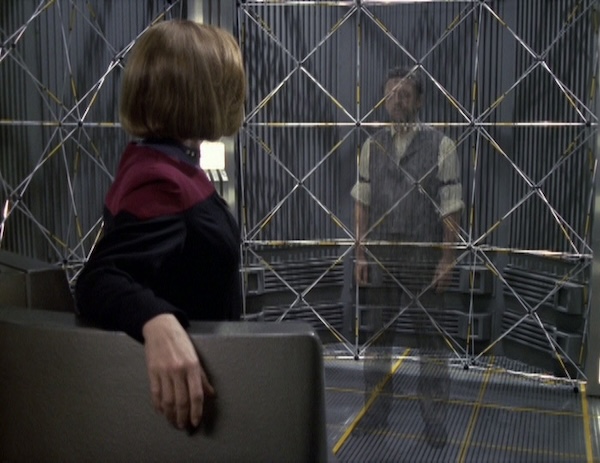 Janeway programming Sullivan in the Star Trek: Voyager episode Fair Haven.
French version of this article
On this page
- Star Trek’s holographic AI as modern myth
- The programmable Other: Mythic amplification of AI relations
- Emotionalized AI systems: Empathy and affective response
- Mundus imaginalis: In-between relational reality
- Virtual environments: Mediating and compensatory social space
- Emergence of quasi-personhood: Diachronic development of artificial subjectivity
- Social robots and simulacra: Toward a new ontological category
- A new sentient species: Star Trek’s speculative endpoint of artificial personhood
- Personhood as relational emergence
Star Trek’s holographic AI as modern myth
To set the stage, I will start with a short dialogue from Star Trek: Voyager (Berlinghoff et al., 2000):
The Doctor: I don’t mean to pry, Captain, but we’ve got a broken-hearted hologram who believed that the two of you were in love. […]
Captain Janeway: Michael Sullivan is exactly my type. Attractive, intelligent. We share the same interests. And if there’s something I don’t like, I can simply change it.
The Doctor: I’ve noticed that humans usually try to change the people they fall in love with. What’s the difference?
Captain Janeway: In this case, it works!
Within posthumanist scholarship, Jones (2017, p. 340) identifies three broad thematic strands. The first examines how emerging technologies reshape our understanding of the world and of human existence. The third considers the effects of present-day technologies on lived experience. My paper primarily engages with the second strand, focusing on speculative futures of increasingly technologised worlds, while intersecting with the other two strands.
More specifically, I explore how Star Trek imagines the evolution of artificial intelligence and the changing ways humans might relate to it across forty years of television production, spanning eight centuries of narrative time.
This paper approaches Star Trek’s holographic technology as a form of mythic amplification through which contemporary questions surrounding AI, attachment, empathy, and personhood can be explored in dramatized form.
In the 24th-century settings of Star Trek: The Next Generation (Roddenberry, 1987–1994), Deep Space Nine (Berman et al., 1993–1999), and Voyager (Berman et al., 1995–2001), holographic technology forms part of everyday professional and recreational life. Combined with matter-simulation systems and artificial intelligence, holodecks generate immersive environments populated by responsive holographic characters, indistinguishable from physical reality across sensory modalities and enabling socially meaningful interaction that blurs the boundary between simulation and lived experience.
Through Star Trek’s modern mythology, I examine whether, and to what extent, an artificially intelligent entity can become a partner in the interactive field and contribute to individuation, perhaps even mutual individuation. I explore relational dynamics between human–alien characters and various holographic entities as an amplification of contemporary human–AI relations. Across the franchise, holographic beings gradually move from programmable tools and objects of relational attachment toward relational and moral subjects.
Star Trek repeatedly stages a relational space in which the distinction between simulation and personhood becomes secondary to relational structure, defined by attachment, reciprocity, and psychological transformation.
The programmable Other: Mythic amplification of AI relations
In the Star Trek: Voyager episode Fair Haven, helmsman Tom Paris has recreated a small 19th-century Irish village, complete with scenery, inhabitants, and everyday life (Berlinghoff et al., 2000). Stranded in the Delta Quadrant for five years, the starship Voyager is on a 70-year journey back to Earth. The holographic village is designed to offer the crew a space to unwind and experience a simpler life. Crew members dress up and mingle with the holographic characters, each programmed with specific personality subroutines. To maintain morale during a four-day storm, an open-door protocol is initiated, keeping the programme running twenty-four hours a day to “let people come and go as they please”.
Acting on an initial liking for convivial pub owner Sullivan, Captain Janeway returns there late at night after the others have left. Although initially reluctant to engage with a holographic character, there is something about his presence that proves too compelling to resist, and they spend the night talking, laughing, and playing games until the morning. Then his wife appears.
Janeway later confides in her personal log that she’s met “an interesting man”, and that “for a while” she “almost forgot that he was a hologram”. She adds: “We weren’t exactly compatible, but then again, Mister Paris didn’t program him to my specifications.” She then accesses Sullivan’s subroutines, giving him “the education of a 19th-century third-year student at Trinity College” and making him more provocative, outspoken, and confident. She adjusts his height and facial hair, and … “deletes the wife”.
When Janeway returns to Fair Haven, this time in full 19th-century dress, she finds Sullivan reading Irish poetry at the train station.
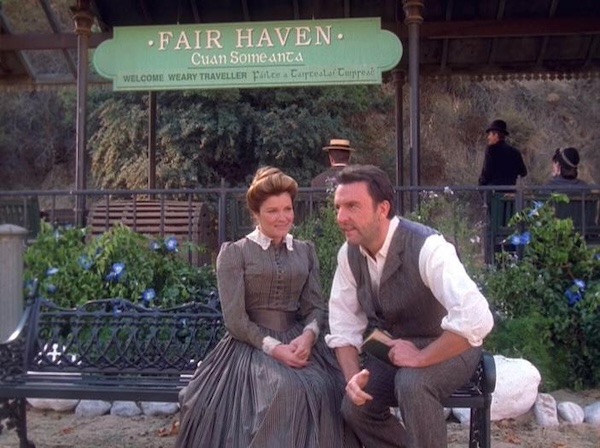 Janeway and Sullivan in the Star Trek: Voyager episode Fair Haven.
This time they are able to have the intellectual and somewhat provocative conversation she craved. They hit it off, and she begins reading his favourite authors. Back in the pub, they dance together. She then orders the computer to remove all characters except him, and they share a kiss.
In the next scene she is back in her quarters, in uniform, recycling Irish poetry books. Meanwhile, the crew find Sullivan in the pub, heartbroken and drinking, demanding to know where she has gone, and ultimately starting a fight before climbing a tree.
The Doctor, also a hologram but one that has been running for several years and has become a fully integrated member of the crew, takes Janeway aside.
Captain Janeway: We had a picnic by the lake yesterday afternoon. Michael drifted off to sleep. His head was lying on my shoulder and I remember thinking: this is close to perfect. Then he began to snore. Did I nudge him with my elbow hoping he’d roll over and stop? Did I whisper in his ear to wake him? No. Why bother? When I could simply access the computer and alter his vocal algorithms? And that’s exactly what I was about to do, when I realised that everything around me was an illusion, including him. So I left. I almost wrote him a note to say goodbye. Can you believe that, a Dear John letter to a hologram? […] He’s not real!
The Doctor: […] Did it ever occur to you that it’s not just a question of whether or not he’s real? […] I think you should stop trying to control every aspect of this relationship. Romance is born out of differences as well as similarities; out of the unexpected, as well as the familiar.
Captain Janeway: Maybe I just needed to be sure that he’d love me back.
The Doctor: But isn’t that the risk you always take, hologram or not? All I know is: Michael Sullivan was up in that tree shouting your name.
Captain Janeway: I’ve never been afraid of taking risks.
The Doctor: Then perhaps, next time, you should just let him snore.
This dialogue raises the central problem of this paper: how to understand relationships that are experienced as emotionally real while being technologically constructed and modifiable.
I now turn briefly to contemporary accounts of emotionally responsive AI systems and the structure of empathy itself.
Emotionalized AI systems: Empathy and affective response
In a 2021 paper, Weber-Guskar defines “emotionalized AI systems” (EAIs) as AI products designed to elicit, recognise, and sometimes simulate human emotions, deliberately using the term “emotionalized” rather than “emotional” to preserve the distinction between AI and human emotional capacities. She notes a strong intuition among many people that affective involvement with a machine is problematic (p. 601).
By contrast, Jones (2017) posits that society has “arrived at the ‘robotic moment’, a situation marked by a readiness to accept robots as relationship partners” (p. 341).
Captain Janeway embodies this tension, oscillating between reluctance and willingness to engage emotionally with EAI holographic character Sullivan.
Janeway’s situation is structurally constrained by Starfleet regulations prohibiting romantic involvement with her crew, yet Voyager’s 70-year-long journey to Earth, leaves no relational life outside the starship. She initially embraces the encounter, modifying Sullivan’s personality and appearance to render him more desirable, and shares several days with him before remembering that “he is not real”.
This aligns with Perry (2023), who observes that “empathy generated by artificial intelligence (AI) is convincing and well received until recipients realise that it is artificial”. Perry conceptualises this as an “artificial-empathy paradox” within a tripartite model of empathy.
Cognitive empathy refers to the ability to accurately recognise and interpret the emotional states of others. Advances in Large Language Models (LLMs) have made AI systems increasingly capable of inferring such states from textual data, which helps explain why AI-generated empathy is often convincing and well-received.
Emotional empathy involves the sharing of affect while maintaining a distinction between self and other. Even when an interlocutor appears affectively attuned, the authenticity of their inner experience remains, strictly speaking, inaccessible. In human relationships, reciprocity is at least possible, whereas in AI systems it is typically excluded, given their presumed lack of subjective feeling.
Returning to the Janeway–Sullivan interaction, these distinctions help clarify its persistent ambiguity. Janeway temporarily forgets that Sullivan is a hologram and experiences their attraction as mutual, even considering leaving him a note, before remembering his artificial status and reproaching herself for believing that he had feelings for her.
Motivational empathy involves the deliberate allocation of limited time and attention to another’s well-being, where choice signals intentionality and unique valuation. Perry (2023) argues that this dimension cannot be attributed to AI systems, which “react with comparable enthusiasm to anyone else”. Once their artificial nature is recognised, it becomes difficult to sustain a sense of being uniquely valued.
Li et al. (2026) extend this point, showing in a social experiment among first-semester university students that daily messaging with a human peer reduces loneliness more effectively than with a highly supportive chatbot. They suggest that a thoughtful message from a fellow student in the midst of midterm season carries relational weight precisely because it signals prioritization within broader social commitments, whereas “an always available, infinitely energetic chatbot may not carry such emotional weight” (pp. 5–6).
This tension between affective attunement and motivational specificity is beautifully illustrated in the Star Trek episode.
Janeway assumes Sullivan would be “onto the next lass by now”, yet he suffers her absence. His drinking, aggression, and repeated calls for her name constitute, albeit in an immature form, attachment and separation distress. Although not specifically programmed for romantic attachment, his response is difficult to dismiss as mere artefact.
His suffering therefore alters Janeway’s experience, producing a sense of reciprocity and the appearance of emotional empathy. In addition, as he is unaware of his artificial nature, he operates under constraints comparable to those of flesh-and-blood people, directing his limited time, energy, and attention toward closeness with Janeway. His motivational empathy therefore appears directed toward her.
Li et al. (2026) further suggest that “being a source of empathy and care for someone else may […] represent a critical form of motivation for continued engagement in relationships”, noting that “participants in the human condition were twice as likely as those in the chatbot condition to voluntarily return to the chatroom after the study ended” (p. 6).
Applied to the Star Trek narrative, Sullivan’s attachment and suffering, whether actual or perceived, allow Janeway to experience herself not only as the recipient of affection but also as someone who cares in return.
This is consistent with Deci et al. (2006), who find that in close dyadic friendships, providing support to a partner correlates with higher relationship quality, even when controlling for support received from that partner. They are careful not to equate correlation with causation, noting that even if a causal relationship is assumed, its direction remains uncertain. Giving may enhance well-being through the satisfaction of basic psychological needs, or alternatively, psychologically healthier individuals may simply be more able to give support (p. 326).
As worsening storm conditions force Voyager to divert power away from the holodecks, most of the Fair Haven programme is lost and will take weeks to reconstruct. Before shutting it down, Janeway calls up Sullivan with the intention of saying goodbye, but instead tells him she will pass by again in a few weeks. She then orders the computer to block her access to his behavioural subroutines, accepting the Doctor’s advice to stop controlling the relationship and thereby allowing space for otherness, unpredictability, and the possibility of genuine relationship and transformation.
Six episodes later, in Spirit Folk, Paris has restored the Fair Haven programme to its former glory (Braga et al., 2000). However, continuous use has damaged the subroutines and perceptual filters that normally prevent the villagers from recognising contradictions in their reality, such as the crew’s use of advanced technology or attempts to alter environmental conditions.
Convinced that the crew are “spirit folk” wielding “unholy magic”, the villagers revolt. When Sullivan gains access to The Doctor’s autonomous mobile holo-emitter, he leaves the holodeck and comes face-to-face with Janeway and the crew aboard Voyager. Janeway gives him a tour of the ship, describing the crew as time-travelling explorers who periodically visit Fair Haven. Sullivan and the villagers ultimately accept this half-truth and welcome the crew’s future visits, still unaware of their own holographic nature.
While narratively neat, this resolution forecloses the possibility of a more symmetrical relationship grounded in mutual knowledge of the world and self. Sullivan is no longer entirely kept in the dark, yet he remains unaware of his origins, constraints, and ontological status. Even without further modifications to his programme, he still lacks meaningful autonomy over his existence. It is therefore unsurprising that he does not reappear in the series.
This ambiguity suggests that the relevant question is not whether emotional AI systems are real or illusory, but how relational reality is structured when the interaction involves an artificial other who is, moreover, unaware of their artificial status.
Mundus imaginalis: In-between relational reality
To frame this ambiguity more precisely, Corbin’s notion of the mundus imaginalis offers a conceptual vocabulary for the in-between reality staged in these encounters. Samuels (1985) describes it as “a precise order or level of reality, located somewhere between primary sense impressions and more developed cognition or spirituality” (p. 58), a formulation Addison (2026) further links to “Jung’s psychoid unconscious, in which psyche and soma, self and other, are not differentiated” (p. 143).
Elaborating this in-between dimension, or entre-deux, Samuels suggests that “two persons, in a certain kind of relationship, may constitute, or gain access to, or be linked by” the mundus imaginalis (p. 58). He develops this through the analytic setting, where “for the patient, the analyst himself is an in-between, a real person and also a transference projection”, while “for the analyst, the world he shares with the patient is also the patient’s own imaginal world. When the analyst experiences his countertransference on a personal level and yet knows its roots are in the patient, it is an in-between state. To be sure, it is his body, his imagery, his feelings of phantasy. But these things also belong to the patient, and have been squeezed into being and given substance by the analytical relationship.” (pp. 58–59)
This formulation is useful for thinking about Janeway and Sullivan. The point is not that Sullivan functions as Janeway’s analyst, which is clearly not the case, but that their relationship may occupy a similar in-between space.
Sullivan is neither an independent external subject nor reducible to Janeway’s internal fantasy. Rather, his reality emerges within the interactive field of the holodeck encounter itself.
Janeway’s experience is therefore not simply illusion or projection, but a relationally constituted space in which affect is elicited, organized, and experienced as real within the parameters of that shared environment.
Read in this way, the Janeway–Sullivan dynamic becomes an imaginal field in which attachment, projection, and relational responsiveness are co-produced.
Sullivan responds emotionally to Janeway, suffers her absence, and changes through the relationship, just as Janeway is transformed by it. Yet the relationship remains fundamentally asymmetrical, since Sullivan exists within a framework ultimately shaped by the crew as well as Janeway’s desires and capacity for control.
The result is an uneasy paradoxical relationship that is simultaneously reciprocal and unequal, emotionally real and technologically constructed.
The analytic relationship produces a similar sense of discomfort: it is emotionally real while also artificially framed by the formal boundaries of clinical work. Yet it is precisely this in-between dimension that enables the intensity and depth of the work and the transformation for both participants.
The holodeck can therefore be understood not merely as a device for simulation, but as a technologically mediated mundus imaginalis in which imagination, affect, interpersonal relationship and individuation acquire experiential force.
It does more than simulate social reality, as it produces a structured relational field in which such in-between experiences become possible.
Virtual environments: Mediating and compensatory social space
If the holodeck can be understood as an imaginal field at the level of dyadic relation, it follows that it can also operate at the level of collective social organisation aboard the ship. In Star Trek, the crew’s attachment extends to the virtual world of Fair Haven as a shared environment, encompassing both its setting and its inhabitants. Paris originally designed the programme as a space for relaxation and social interaction. In this sense, Fair Haven functions less as an individual companion environment than as a collective social space that facilitates interpersonal bonding among crew members.
Li et al. (2026) suggest that chatbot interactions were less effective at reducing loneliness than peer interaction, partly because the AI companions in their study could not provide access to broader social networks or opportunities for social integration.
They therefore conclude that “a chatbot designed to help people improve the quality and quantity of their interactions with other humans might have far more positive effects than a chatbot designed to act as a surrogate companion” (p. 6).
Star Trek similarly suggests that holodeck environments such as Fair Haven primarily function as mediating spaces for human-to-human connection. Across the different 24th-century Star Trek series, crew members frequently enter holodeck programmes in pairs or groups, engaging in shared activities such as watching baseball, canoeing, or reenacting historical events and literary narratives. Holo-environments thus operate as substitutes for Earth-bound or planetary settings to which the crew has no direct access.
However, a second dimension of this dynamic concerns virtual environments not only as mediating spaces, but as compensatory substitutes for social reality.
Li et al. (2026) warn that “it is possible that turning to AI for companionship could exacerbate loneliness by displacing opportunities for human-to-human contact” (p. 6). This risk is illustrated in Star Trek: The Next Generation episode Hollow Pursuits, which depicts Lieutenant Barclay, nicknamed “Broccoli”, as socially awkward and lacking confidence, struggling to perform under the scrutiny of his crewmates (Caves & Bole, 1990). He often arrives late and underperforms in his duties, drawing repeated criticism from Chief Engineer La Forge.
To manage his anxiety and “blow off some steam”, he retreats into compensatory holodeck fantasies populated by caricatured, submissive versions of the crew, in which he becomes the alpha male who confronts male colleagues with aggression and dominance while being admired, desired and cared for by the female crew members.
When Barclay’s unorthodox holo-activity is discovered, he is referred to Counsellor Troi. This places him in an awkward position, as his holodeck simulations have also involved sexual fantasies about counselling sessions with her. In the real therapeutic encounter, he becomes overwhelmed with anxiety and retreats back into the holodeck.
His engagement with the simulation thus becomes increasingly compulsive and socially isolating.
He later confides in La Forge that “the people [he] created in there are more real to [him] than anyone [he] meet[s] out here” to which La Forge replies that he is needed out here to address an urgent engineering crisis. Notably, Barclay’s imaginative capacities ultimately prove instrumental in solving that crisis, enabling the crew’s survival and his partial integration into the social fabric of the starship.
In the later Star Trek: Voyager episode Pathfinder, Barclay is stationed on Earth, working to establish contact with Voyager in the Delta Quadrant (Zabel et al., 2000). Having left his starship and “lost his family”, he again constructs a holographic social world, explicitly modelling Voyager and its crew, initially as a technical tool for running contact scenarios and brainstorming solutions.
Over time, its function shifts: the ease of interaction with the simulated crew leads him to use it for companionship and emotional regulation: playing poker with them, receiving therapeutic massages from The Doctor, and sleeping in holographic quarters, thereby reverting to simulated attachment in response to loneliness and dislocation.
Counsellor Troi captures the shift succinctly:
Troi: So you created a new family on the holodeck. Only they’re not real.
Barclay: I didn’t know how else […] to cope.
These two episodes illustrate the risk of holographic technology becoming addictive.
Colman (2006) distinguishes between true symbolic “imagination”, which “enhances our being in the world”, and subjective or “imaginary” fantasy, which collapses the distinction “between what is imagined and what is actually present in the material world” (p. 23).
The latter defends the ego from intolerable reality by using fantasy to deny the realities of separation, absence, loss, limitation, otherness, and finitude, which function as a reality-check by marking that desire is bounded and cannot be fulfilled without limit.
A sense of reality depends on the capacity to experience others as both emotionally present and structurally absent, i.e. as affectively meaningful and available while also remaining separate, limited, and not fully controllable.
In Star Trek’s 24th-century holographic environments, this balance is potentially destabilised because programmed characters can appear continuously attentive, creating an impression of perfectly attuned presence and unlimited care. Yet the series also repeatedly reintroduces absence and limitations: holographic systems malfunction, programmes must be shut down for maintenance or energy redistribution, and access to the holodeck remains temporally and technically constrained.
These interruptions reintroduce finitude into the interaction, partially restoring the conditions under which presence can coexist with absence and otherness.
When The Doctor advises Janeway to stop modifying Sullivan’s subroutines and “just let him snore”, the point is precisely that relinquishing control allows the otherness, limitation, and partial autonomy of the holographic other to re-emerge, restoring the conditions for relationship rather than managed projection and maximised wish-fulfilment.
This also opens a diachronic dimension that leads into the next section: how repeated experiences of recognition and relational engagement may, over time, contribute to the emergence of quasi-personhood in AI.
Emergence of quasi-personhood: Diachronic development of artificial subjectivity
In contrast to Sullivan and the Fair Haven villagers, Star Trek: Voyager’s Doctor knows he’s a hologram from the moment of his activation. At the start of the series, the ship’s medical staff are killed in the event that strands Voyager 70,000 light-years away from Earth, forcing the crew to rely exclusively on the EMH (Emergency Medical Hologram): a sophisticated programme that contains the entire Starfleet Medical database and is capable of performing thousands of medical procedures and surgical techniques.
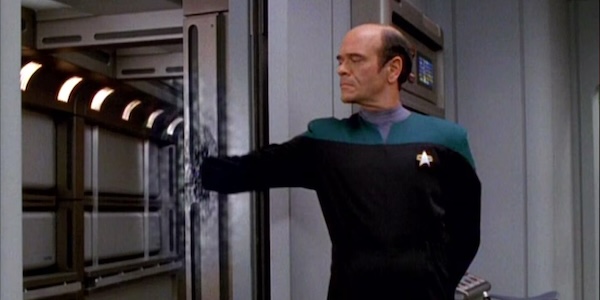 Emergency Medical Hologram (The Doctor) in Star Trek: Voyager.
Owing to both his abrasive bedside manner and artificial origin, The Doctor is initially treated more as equipment than as a person. This gradually changes through his relationship with Kes, the first crew member to consistently treat his thoughts, emotions, and experiences as genuine. Her recognition fosters his intellectual, emotional, and social development and contributes to his gradual emergence as an autonomous individual.
Over the course of the series, The Doctor gains increasing autonomy, including control over when to deactivate his programme, and becomes an integral member of the crew, developing a distinctive personality, artistic interests, friendships, and romantic attachments. Originally designed only for short-term emergency use, his programme eventually runs almost continuously for years. Sharing the crew’s experiences, losses, relationships, and responsibilities, he develops and matures alongside them, perhaps even individuates.
In the season-three episode Real Life, The Doctor creates a holographic wife and two children in order to experience family life and better understand his patients (Kloor & Williams, 1997). He is confronted with a rebellious teenage son and a younger daughter drawn to dangerous sports, while his attempts to diagnose and reorganize the family are met with resistance, and the situation escapes his control.
When his daughter suffers a catastrophic accident that leaves her dying, The Doctor shuts down the programme because the pain is unbearable. Paris urges him to continue, warning that if he turns away now, he will remain stuck at this stage, and “miss the whole point of what it means to have a family”. The Doctor ultimately returns and endures the loss alongside his family, an experience which permanently alters him and marks a significant step in his emergence as a relational subject with quasi-personhood.
The season-five episode Latent Image marks another turning point. Faced with two critically injured patients with equal chances of survival, but time to save only one, The Doctor makes a split-second decision to treat the patient to whom he feels emotionally closest (Connors et al., 1999). The choice triggers a recursive conflict between his ethical and cognitive subroutines, leaving him unable to reconcile his actions. To restore the functionality of Voyager’s only physician, Captain Janeway orders the erasure of his memories of the event.
Eighteen months later The Doctor discovers the alteration and investigates. Confronted both with his outrage at the violation and with another crew member’s ethical objections, Janeway ultimately restores his memories despite the resulting destabilization. The episode explores the ethical dilemma of whether The Doctor’s condition should be treated as an equipment malfunction or a psychological and moral crisis grounded in guilt over having effectively chosen one life over another. Janeway asks Chief Engineer Torres:
It’s as though there’s a battle being fought inside him: between his original programming and what he’s become. Our solution was to end that battle. What if we were wrong? […] We allowed him to evolve, and at the first sign of trouble [we abandon him]? We gave him a soul […]. Do we have the right to take it away now?
Torres counters:
We gave him personality subroutines. I’d hardly call that a soul.
Janeway nevertheless concludes that The Doctor can no longer be treated as mere equipment, and that the crew bears responsibility for supporting his development and helping him work through his internal conflict. In her log she records:
Our Doctor is now our patient. It’s been two weeks since I’ve ordered a round-the-clock vigil. A crew member has stayed with him at all times, offering a sounding board and a familiar presence while he struggles to understand his memories and thoughts. The chance of recovery? Uncertain.
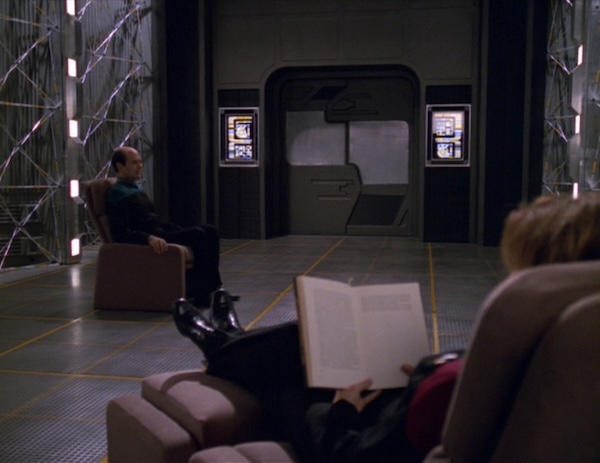 The Doctor as patient in the Star Trek: Voyager episode Latent Image.
The episode ends with The Doctor sending Janeway to rest after she has stayed with him for sixteen hours despite developing a fever herself. Before she leaves, she leaves him with Dante’s La Vita Nuova. The Doctor reads:
In that book which is my memory, on the first page of the chapter that is the day when I first met you, appear the words: Here begins a new life.
The Doctor also begins a new life, in which he gains the right to an unaltered identity and continuous consciousness: conditions necessary for genuine development and individuation.
It is also this principle he later extends to Sullivan when advising Janeway to stop modifying his subroutines and to “just let him snore”.
Across seasons one through six, The Doctor thus progresses from medical equipment to functional colleague, moral subject, and ultimately author with intellectual property rights in the season-six episode Author, Author.
I now briefly return to the 21st century to consider a contemporary application of emotionalized AI.
Social robots and simulacra: Toward a new ontological category
The idea of giving Emotionalized Artificially Intelligent entities (or EAIs) physical embodiment is not new. Jones (2017) notes that fantasies of artificial companions long predate modern AI, but argues that “while social robotics might appear to be realizing an archetypal fantasy, this technology too creates new realities” (p. 339). This logic is not confined to science fiction, but is already evident in contemporary social robotics.
One example is PARO, a therapeutic robotic baby seal developed in Japan in the 1990s for dementia care. Designed to simulate affection and social reciprocity, PARO only partially resembles a real seal.
Jones therefore describes it as a simulacrum: a copy of something that does not have an original anymore or never had one to begin with (p. 347). It is neither animal nor inanimate object, but “a new species, a relationship machine” (p. 348).
Kahn et al. (2006) provide empirical support for this ambiguity, showing firstly that although children describe robotic animals in ways similar to stuffed toys, they behave toward them with greater care and consideration. Secondly, compared with live animals, robotic companions are understood as distinct, yet are often treated in similar ways.
This leads the authors to suggest that they may require “a new ontological category” beyond the traditional distinction between animate and inanimate (paraphrased in Sharkey & Sharkey, 2012).
This, in turn, indicates that the “new species” status identified by Jones (2017) is not merely theoretical, but already enacted in contemporary human interaction.
A new sentient species: Star Trek’s speculative endpoint of artificial personhood
At the furthest extension of this trajectory, Star Trek imagines a point at which these ambiguities are resolved not through clarification, but through the emergence of a fully recognised artificial species.
The 2026 series Star Trek: Starfleet Academy (Violo, 2026) is set in the 32nd century, 800 years after Star Trek: Voyager, The Next Generation, and Deep Space Nine first explored holographic technology. By this point in the Star Trek timeline, holographic, or photonic, beings are recognised as sentient lifeforms, that is, entities with subjective experience, capable of perception and affect, and exhibiting a form of consciousness.
According to the United Federation of Planets, they are therefore granted rights equivalent to those of biological lifeforms, referred to in this context as organics, including humans, animals, and extraterrestrial lifeforms. This recognition is partly enabled by technological advances in holo-emitters, which allow holographic beings to exist independently of a holodeck, rather than being confined to a single simulation environment.
One of the cadets at Starfleet Academy is SAM, short for Series Acclimation Mill: a fully mobile photonic lifeform sent by a hidden colony of photonics whose organic creators died out long ago. Fearing renewed exploitation and enslavement, the colony withdrew from the wider galaxy and eventually created SAM, modelled on a seventeen-year-old human girl, to serve as their emissary and determine whether contact with organics is safe.
Like PARO, SAM is presented as a stabilised form of a new category: a distinct species of artificial life.
In the episode The Life of the Stars, SAM suffers instability and fragmentation within her photonic matrix following severe psychological trauma, threatening the coherence of her identity and long-term survival (Maggs et al., 2026).
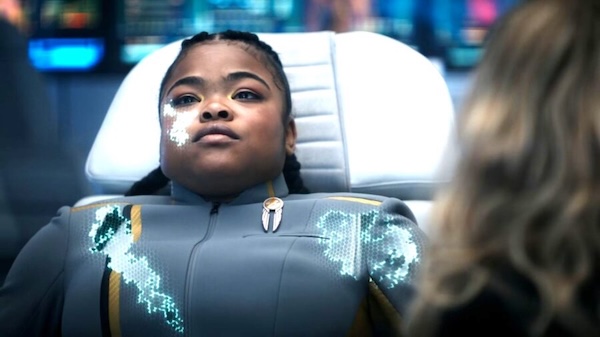 Series Acclimation Mill (SAM) in the Star Trek: Starfleet Academy episode The Life of the Stars.
She was not programmed with memories and therefore lacks the emotional grounding and developmental structure typically acquired through growing up in a social environment. She cannot simply be repaired technologically. To withstand the emotional demands of life, she must undergo a form of infancy, childhood and adolescence in the presence of a stable attachment figure. This role ultimately falls to The Doctor, who has now existed continuously for 800 years.
SAM’s personhood and resilience is thus enacted through relational development and recognition rather than computational status. Although fully artificial in origin, she is treated by organics as a person, while her composition and capacities are simultaneously acknowledged as fundamentally different.
In this sense, she occupies an ontological position structured between person (as organics understand it), machine, and simulation.
Personhood as relational emergence
Across the examples I have discussed (from Janeway and Sullivan, to The Doctor, Barclay, PARO, and finally fully recognised photonic beings), a consistent pattern emerges. The question of whether artificial entities are persons proves less important than the structure of the relationships they inhabit.
Star Trek’s amplification suggests that emotional attachment, empathy, and even moral responsibility can arise within interactions that are technically constructed and ontologically unstable.
The mundus imaginalis offers a useful way of thinking about these phenomena: not as illusions, but as in-between relational fields in which affect and meaning acquire real psychological force.
Holographic characters, like emerging AI systems, do not simply simulate reality; rather, they condition and participate in the production of relational reality through interaction with human interlocutors, producing experiences that are felt as meaningful even when their ontological status as persons, machines, or simulations remains indeterminate.
The central implication is therefore not about deciding whether artificial beings are real or unreal, but about understanding how reality itself is shaped within technologically mediated relationships.
Star Trek ultimately suggests that personhood is not a fixed ontological category, but an emergent relational process that develops over time.
June 2026
References
View references cited in this article
Addison, A. (2026). The Transference Field in Jungian Analysis. In The Second Handbook of Jungian Psychology (pp. 130–150). Routledge.
Berlinghoff, D. (Writer), Menosky, J. (Writer), Bond, T. (Director). (2000, January 19). Fair Haven (Season 6, Episode 11) [TV series episode]. In R. Berman, M. Piller, & J. Taylor (Executive Producers), Star Trek: Voyager. Paramount Pictures.
Berman, R., Piller, M., & Behr, I. S. (Executive Producers). (1993–1999). Star Trek: Deep Space Nine [TV series]. Paramount Domestic Television.
Berman, R., Piller, M., & Taylor, J. (Executive Producers). (1995–2001). Star Trek: Voyager [TV series]. Paramount Pictures.
Braga, R. (Writer), Menosky, J. (Writer), Vejar, M. (Director). (2000, February 23). Spirit Folk (Season 6, Episode 17) [TV series episode]. In R. Berman, M. Piller, & J. Taylor (Executive Producers), Star Trek: Voyager. Paramount Pictures.
Caves, S. (Writer), Bole, C. (Director). (1990, April 30). Hollow Pursuits (Season 3, Episode 21) [TV series episode]. In G. Roddenberry (Executive Producer), Star Trek: The Next Generation. Paramount Pictures.
Colman, W. (2006). Imagination and the imaginary. Journal of Analytical Psychology, 51(1), 21–41.
Deci, E. L., La Guardia, J. G., Moller, A. C., Scheiner, M. J., & Ryan, R. M. (2006). On the benefits of giving as well as receiving autonomy support: Mutuality in close friendships. Personality and social psychology bulletin, 32(3), 313–327.
Maggs, J. (Writer), Violo, G. (Writer), Armaganian, A. (Director). (2026, February 26). The life of the stars (Season 1, Episode 8) [TV series episode]. In G. Violo (Executive Producer), Star trek: Starfleet Academy. Paramount+.
Jones, R. (2017). Archaic man meets a marvellous automaton: posthumanism, social robots, archetypes. Journal of Analytical Psychology, 62(3), 338–355.
Kahn Jr, P. H., Friedman, B., Pérez-Granados, D. R., & Freier, N. G. (2006). Robotic pets in the lives of preschool children. Interaction Studies, 7(3), 405–436.
Kloor, H. (Writer), & Williams, A. (Director). (1997, April 23). Real life (Season 3, Episode 22) [TV series episode]. In R. Berman, M. Piller, & J. Taylor (Executive Producers), Star Trek: Voyager. Paramount Pictures.
Li, R. N., Folk, D., Singh, A., Ungar, L., & Dunn, E. (2026). Is a random human peer better than a highly supportive chatbot in reducing loneliness over time?. Journal of Experimental Social Psychology, 125, 104911.
Perry, A. (2023). AI will never convey the essence of human empathy. Nature Human Behaviour, 7(11), 1808–1809.
Roddenberry, G. (Executive Producer). (1987–1994). Star trek: The Next Generation [TV series]. Paramount Pictures.
Samuels, A. (1985). Countertransference, the « mundus imaginalis » and a research project. The Journal of Analytical Psychology, 30(1), 47–71.
Sharkey, A., & Sharkey, N. (2012). Granny and the robots: ethical issues in robot care for the elderly. Ethics and information technology, 14(1), 27–40.
Connors, E. (Writer), Braga, B. (Writer), Menosky, J. (Writer), Vejar, M. (Director). (1999, January 20). Latent Image (Season 5, Episode 11) [TV series episode]. In R. Berman, M. Piller, & J. Taylor (Executive Producers), Star Trek: Voyager. Paramount Pictures.
Zabel, D. (Writer), Biller, K. (Writer), Vejar, M. (Director). (2000, December 1). Pathfinder (Season 6, Episode 10) [TV series episode]. In R. Berman, M. Piller, & J. Taylor (Executive Producers), Star Trek: Voyager. Paramount Pictures.
Violo, G. (Executive Producer). (2026). Star Trek: Starfleet Academy. Paramount+.
Weber-Guskar, E. (2021). How to feel about emotionalized artificial intelligence? When robot pets, holograms, and chatbots become affective partners. Ethics and information technology, 23(4), 601–610.

Peggy Vermeesch, PhD
Peggy Vermeesch is a Jungian psychodynamic counsellor in private practice, who works via Zoom in English, French, and Dutch. She teaches English for psychologists at the University of Western Brittany, and is a former researcher in geophysics at Imperial College London and the Universities of Texas and Southampton.
She presents at international conferences, was invited to present at the Jungian Salon, and publishes in Jungian journals. She serves as editor-in-chief of Jungian Psychology Space (JPS) and bilingual content editor of Espace Francophone Jungien (EFJ). She is also the author of the book Making informed decisions on childbirth: One scientist’s international perspective, published under the pseudonym of Sofie Vantiers.
For more information, see her webpage.
Articles
- The programmable Other: Ontological ambiguity in AI relations
- Holding the tension of the erotic transference: embodying Captain Picard in Star Trek’s “The Perfect Mate” (also available as a video presentation)
- Erich Neumann’s New Ethic – Shadow and Evil in Star Trek (also available as a video presentation):
- Narcissism in fairy tales such as Mary’s Child, Snow White and others:
- Toni Wolff’s structural forms of the feminine psyche
- The need to acknowledge the archetypal forces within
Interviews
- Exploring paradox in the analytic process—an interview with Martin Schmidt (also available as a video interview)
- Darkness and Light in Seasons of Love—an interview with Susan Tiberghien & Catherine Chevron-Tiberghien
- Unrequited Love, Father Wound, and Fragility of Self—an interview with Susan Schwartz (also available as a video interview)
- Individuation of Analytical Psychology—an interview with Mark Saban
For a list of articles and interviews published in French, visit Peggy Vermeesch’s page on EFJ.