


Drawing on correspondence and archival material, Martin Liebscher explores the tensions between Erich Neumann and Michael Fordham, whose contrasting approaches placed them on opposing sides of an emerging divide within analytical psychology.
Their disputes over child psychology, archetypes, heredity, and empirical evidence expose a deeper question: how Jung’s psychology was to be understood, developed, and carried forward by the generation that followed him.
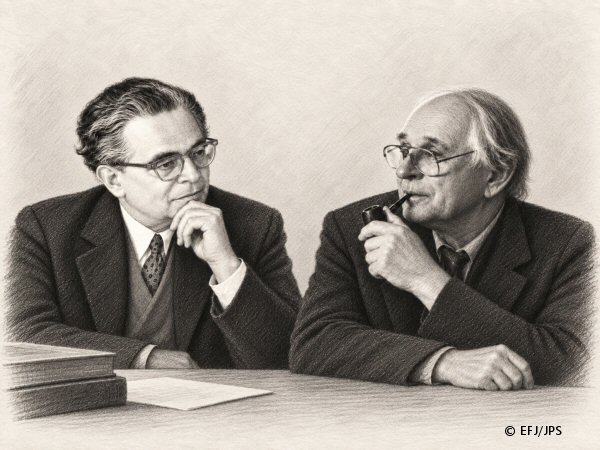
Erich Neumann and Michael Fordham, imagined in dialogue. AI-generated pencil drawing based on historical photographs.
This article is a revised and expanded version of a discussion first published in the introduction to Psychology in Exile: The Jung-Neumann Correspondence (Liebscher, 2015, pp. lvi–lviii).
On this page
- After Jung: Neumann and Fordham
- The making of a conflict
- Two visions of analytical psychology
- Fordham’s critique of Neumann
- Competing inheritances of Jung
After Jung: Neumann and Fordham
“Poetry” and “the regressive English school” are expressions of contempt that were used by Michael Fordham and Erich Neumann to describe the theory of the respective other.
Both were confidants of Jung belonging to the generation that was expected to take up the torch from Jung and carry Jungian psychology further into a new age. Yet they had quite a different understanding of how the future of analytical psychology should look like. Tensions arose from the very beginning, with animosities mostly playing out through third parties such as Jung himself or his assistant Aniela Jaffé.
The making of a conflict
It was perhaps Jung himself who started the argument through his very generous preface to Neumann’s first major monograph (after Depth psychology and a new ethic), entitled Origins and History of Consciousness from 1949, which was widely regarded as an endorsement of Neumann as his successor. Jung writes:
The book begins just where I, too, if I were granted a second lease of life, would start to gather up the disjecta membra of my own writings, to sift out all those “beginnings without continuations” and knead them into a whole. […] The second generation has the advantage of a clearer, if still incomplete, picture; certain landmarks that at least lie on the frontiers of the essential have grown familiar, and one knows what must be known if one is to explore the newly discovered territory. Thus forewarned and forearmed, a representative of the second generation can spot the most distant connections; he can unravel problems and give a coherent account of the whole field of study, whose full extent the pioneer can only survey at the end of his life’s work.
This difficult and meritorious task the author has performed with outstanding success. He has woven his facts into pattern and created a unified whole, which no pioneer could have done nor could ever have attempted to do. As though in confirmation of this, the present work opens at the very place where I unwittingly made landfall on the new continent long ago […]. (Neumann, 1954b, pp. xiii‒xiv)
Originally intended as a volume to be published on its own, Origins and History of Consciousness had been chosen to become the first volume in the Institute’s series Studien des C.G. Jung Instituts [Studies from the C.G. Jung Institute] (Rascher, 1948). This meant that it would be published under the auspices of the Institute.
One has to call it at least unfortunate that the Institute’s vice-president, C.A. Meier, was just about to finish his major study Antike Inkubation und moderne Psychotherapie [Ancient Incubation and Modern Psychotherapy], which was only second in the pipeline of the series of books. And when Jung in a letter to Jacobi presented Neumann as a role model for Meier, tempers must have flared.
In her letter to Jung in the aftermath of Neumann’s Eranos lecture of 1948, Jacobi started to stir up emotions against the inclusion of Neumann’s book in the series:
I have great concerns as to how such an account will look in a volume of more than 800 pages and if such a book at the beginning of our series won’t dominate all the others to come? There is also the danger that it will be understood as the ‘official’, approved Jungian teaching and not the Neumannian understanding, which in fact it will be. And as Dr Neumann seemed rather unhappy that his book has not appeared yet, he might, perhaps, be delighted anyway, if his book were to be published outside of the series–it would stand up independently, which would be justified by its size anyway. I have only spoken to him briefly. His interest towards me was only limited to business (i.e., the printing of his book) and that has not prompted me to attempt further conversations. The entire Eranos was–even when Mrs Froebe saw it as the best conference so far–a ‘failure’ […]. (Jacobi, 1948)
On this occasion Jacobi’s worries did not fall on fertile ground. Jung emphasised the value of Neumann’s study and honoured the book with the extraordinarily generous preface mentioned above.
But Neumann’s opponents found another opportunity to oppose the publication of The Origins and History of Consciousness in the Institute’s series, when Neumann’s previous book Depth Psychology and a New Ethic was published before Origins and History at the end of 1948. On 10 December Jung wrote to Neumann telling him that the New Ethic had sparked harsh reactions and discussions and that there was a debate going on as to whether the Institute should publish the Origins and History of Consciousness in its series at all (Jung & Neumann, 2015, p. 236).
Of course Jacobi had already set the tone for this discussion after the Eranos lecture. But in his letter, Jung enthusiastically assured Neumann of his support and emphasised the importance of the cathartic effect of such a controversial text. A letter from Neumann to Olga Fröbe-Kapteyn from 25 December 1948 showed Neumann’s delight about Jung’s reaction, which seemed to indicate that Jung would take Neumann’s side:
In the meantime, “Ethic” has come out; I hope that Rascher has sent you a copy, and, as Jung wrote in his very nice letter, it has already caused a stir. To my greatest surprise, even in the Institute itself. (Neumann, 1948)
Yet Jung’s remark that a “small institute, which still stands on weak legs, must not risk too many opponents. (Side glances to university and church!)” should have been a warning sign to Neumann. In his reply Neumann attacked the idea of an institute that would compromise its academic credibility in order to avoid confrontations and added that he would gladly withdraw his book from the series if he was asked to do so (Jung & Neumann, 2015, pp. 238–242).
The use of this more rhetorical addendum turned out to be fatal for the book’s inclusion in the series, when, a month later, he received a letter from C.A. Meier in his capacity as vice-president of the Institute:
Dear colleague, as you have already heard from Jung, in the aftermath of the public and private controversy that was sparked by your New Ethic, the institute has discussed the question as to whether it was right to publish the Origins and History of Consciousness in the publication series of the institute. After an extensive discussion in the board we came to the conclusion that the young institute should not expose itself too much to hefty public controversies.
Hence we prefer, for the time being, to publish texts of a monographic character on detailed questions of complex psychology, which still need a better material and scientific underpinning. It therefore seems also personally right, if your big summarising work is published as a separate publication, and I can understand the decision of the board. I hope that you do not have any difficulties with this decision and assure you that we all await the publication of your book with anticipation. Best wishes, always yours, C.A. Meier. (Meier, 1949)
Neumann responded to Jung, the president of the Institute, in a fuming letter, reiterating his accusations of opportunism and hypocrisy (Jung & Neumann, 2015, pp. 243–245). Jung, in turn, referred to Neumann’s previous letter according to which Neumann did not seem all too eager to publish in the Institute’s series at all (Jung & Neumann, 2015, pp. 246–247).
At the same time that the shock of Neumann’s New Ethic was causing outrage amongst Jung’s supporters in Zurich, Kegan Paul informed Neumann that they would publish an English translation of the book. Neumann asked Jung if he would be willing to write a preface for the English edition. Jung agreed but suggested some changes to the text as one could not expect any knowledge of psychological or philosophical concepts from an English audience. He sent Neumann his detailed amendments and suggested revisions of the text (Jung & Neumann, 2015, pp. 361–369).
The extent of Jung’s ambivalence in this affair is revealed by a letter to Cary Baynes from May 1949:
He [Neumann] wanted me to write a preface to the English edition of it. I have written it but not sent it to him yet. Instead I have sent him a whole list of propositions that he might consider if he wants to have my foreword. His reply was not altogether favourable. He says that he could not write in the way I would, that to him the whole problem is as hot as hell and of immediate urgency. (Jung, 1949)
Cary Baynes was also stirring up the mood against Neumann, as a letter from Marie-Jeanne Schmid, Jung’s secretary, to her shows:
What I would like to write to you about–and how I would wish I could talk it over with you!–is the ‘new star’ Dr. Neumann, i.e., his books. What you wrote about his ‘New Ethic’ made me long for your presence here. Discussion about it is running rather high over here, both in the ‘outer world’ and in the ‘inner circle’. We are even going to have a discussion evening about it among the members of the club [1].
Click here to read the footnote
[1] On 26 March 1949 a discussion on Neumann’s Depth Psychology and a New Ethic took place in the Psychological Club Zurich.
Personally I absolutely agree with you, namely that one wonders whether he knows what he is talking about and–although his big book on the ‘Origins and History’ is better–I also wonder with you whether it ‘really does all that’ namely what C.G. says in his foreword. I wish C.G. had never written it. (Schmid, 1949)
Another opinion came from R.F.C. Hull, the translator of Jung’s works into English, who would also translate Neumann’s Origins and History in the years to come. He expressed his initial reaction to Depth Psychology and a New Ethic in a letter to Michael Fordham from 6 August 1949:
I hope I am not putting my foot in it when I say that this Neumann book seems to me singularly ill-conceived and possibly a dangerous interpretation of Jung’s ideas? If Jung’s strictures on Freud and Jewish psychology have led, in America, to the wild accusations that he was a Nazi, anything may happen if Neumann’s account of the Jungian ‘new ethic’ is taken at its face value–there may be a hurling of epithets like ‘Communist’, ‘immoralist’, ‘Antichrist’ and who knows what! (Hull, 1949)
Here Fordham was confronted with a first negative judgement of Neumann’s work by none other than the translator of Neumann’s Origins and History of Consciousness, R.F.C. Hull.
Yet this was not the first time that Fordham’s name had been mentioned in connection with Neumann’s writings. In his first letter to Jung after the war, after a five-year hiatus, Neumann wrote to Jung on 1 October 1945. In this letter Neumann told Jung about his current work on a book entitled “Archetypal Stages of the Development of Consciousness”, which would later become The Origins and History of Consciousness:
But now I am in the middle of a large work and I would like to arouse your interest in it, i.e. I’d like to briefly tell you about it. ‘Archetypal Stages of the Development of Consciousness’. Myth, childhood, science of neurosis. The first book, ‘Psychology of Myth,’ is almost complete−I’m writing the last chapter of it. Mythology as a projection of the I−and the development of consciousness. The individual stages with their symbols as mythological cycles through which the ‘I’ passes in its development. The archetypal stages as transpersonal pre-conditions which are passed through in the course of the history of humanity and in the individual’s own childhood history.
What is important for me here is, for example, the debate with Freud− which is essential. E.g. When, in the ‘Life of Childhood’, Fordham simply accedes to or takes for granted the Oedipus complex, that simply will not do. Primal parents instead of Oedipus complex, the clarification of the incest stage, the concepts of castration, building on the transformations, which I believe, were superseded by you later. Stages: Uroboros, Great Mother, separation of the primal parental couple, fight with the dragon. From the creation myth to the hero myth. Matricide, patricide, etc., auto conception of the spirit in the Osiris myth and the kings’ ritual.
Much is old, summarising, clarifying, some seems to me to be important as a completion. Represented deductively because it is the only possible way to do it if it is to be clear. Important, amongst other things, for a transpersonal psychology of childhood and for a therapy which can first refer to stages and cycles of symbols but which acquires an orientation in this way. In a sense, a history of the development of the libido in the sense of transpersonal analytical psychology. For sure, it can only be an attempt at something, but perhaps a helpful one. Both for remedial teachers or the child analysts, who work, I say, in a ‘Jungish’ way, as well as for us Jungians ourselves, the lack of such clarifications in the work was always very troubling.
I must say though that child analysis has extremely frequently proved itself to me to be important and decisive in the work. Also in the analyses of the second half of life. Do you have a different opinion about this? The fact that in your publications, the work on the discovery of the archetypes and on the individuation process is centre-staged does not seem to me to be proof of the contrary. It seems to me that problems such as that of the stability of the I and the possibility of its realisation have their roots in childhood experiences. For example, an unsuccessful dragon fight in which the transpersonal contest takes place with the personal parents onto whom the primal parental couple is projected.
So, when the first section is finished, the Psychology of Myth, I will allow myself to send you one ‘for inspection’ and would, of course, be exceptionally grateful to you for any comments on it, all the more as it is crucially important for me to know what your take is on this. My experience is so terribly inferior to yours, the foundations of the work reside in your psychology, so that in a certain sense your approval of my efforts is of essential importance. (Jung & Neumann, 2015, pp. 160–162)
Neumann already sensed at this stage that Fordham’s take on Jungian psychology (and on child psychology) would stand in opposition to his own understanding of it and to what he considered Jung’s original teachings.
In The Life of Childhood Fordham cites the Oedipus myth as the classical example of the process of identification, which would occur universally in childhood (Fordham, 1944, p. 20), and uses it to describe the relationship between the parents and their effect on children: “The development of the child differs according to sex owing to the functioning of the Oedipus and Electra myth, whereby the boy has a negative attitude to the father and a positive erotic one to his mother, while the reverse holds good for the girl” (p. 47).
Two visions of analytical psychology
Years later, in a seminar at the Zurich Institute in 1954, Neumann noted with scepticism a rapprochement between the Kleinian and Jungian schools in England:
What is being reported from England is that the therapy of Klein and the Jungians is almost consistent. Because Melanie Klein is always mythologising further. Question if not what myths are for her, that the child understands her interpretations which are strongly mythologically substantiated, that the child understands and interprets the symbols arising out of this. Question whether the intellectual interpretation which she attributes to this is an essential part or not. (Neumann, 1954a, p. 12)
As is well known, Fordham’s interest in Kleinian thought would eventually lead him to undertake a Kleinian analysis in his later years.
Another of Neumann’s courses at the Institute in 1959 provoked a conflict with Jolande Jacobi (Liebscher, 2015, pp. lii–liii). In the aftermath he expressed his disappointment about the lack of support from the Zurich school, warning of the sceptical attitude towards the possible practical application of analytical psychology by “the regressive English school of Fordham” which would endanger the entire project (Neumann, 1959a).
The antagonism between Neumann and Fordham had already come to the surface a year earlier when Neumann wanted to publish an article in Fordham’s recently established Journal of Analytical Psychology. The article originated from Neumann’s keynote paper at the First International Congress for Analytical Psychology, which was held in Zurich from 7 to 12 August 1958. The title of his presentation was Die Deutung des genetischen Aspekts für die Analytische Psychologie [The Significance of the Genetic Aspect for Analytical Psychology].
Fordham rejected the article in the first instance on grounds of theoretical differences, to which Neumann responded:
I did not know you have a critical attitude towards my work and should be thankful to get known with your criticism. Never did it occur to me that you might reject essays from me for such reasons. This would mean that you do not feel as editor of a Journal for analytical psychology, but as a censor who has to judge about what analytical psychology has to be. (Neumann, 1958)
It has to be said here that Fordham also rejected an article by Aniela Jaffé, who was a close friend of Neumann, as well as, initially and at Jung’s suggestion, a contribution by C.A. Meier.
At the time of this conflict, Neumann wrote to Jung on 20 December 1957:
Now the question. Since my congress lecture also concerns the genetic-phylogenetic aspect of analytical psychology, I would like to enquire of you what Fordham’s for me, suspect, sentence is on about: ‘This clear identity of the view Jung held till recently when, under pressure from biologists, he abandoned the heredity of archetypal images.’ (Jung & Neumann, 2015, p. 336)
The quote stems from Fordham’s review of the collection of essays entitled New Directions in Psycho-Analysis edited by Melanie Klein, Paula Heimann, and Roger Money-Kyrle (Fordham, 1957).
He argued that the Kleinian school of psychoanalysis was getting closer to analytical psychology than to classical psychoanalysis (p. 200). In regard to a contribution by Paula Heimann he stated that this “clear identity of the view Jung held till recently when, under pressure from biologists, he abandoned the heredity of archetypal images, together with the new view of counter-transference already described, led me to consider how much further the Kleinian school has approached analytical psychology and what differences remained” (pp. 197–198).
Neumann continued in his letter to Jung:
You abandoned the heredity of ‘perceptions’ long since, not recently. What is F referring to[?] What, if anything, has changed in your views. The “sun phallus” example cannot be refuted by “biologists” [2].
Click here to read the footnote
[2] Neumann refers to the case of Emil Schwyzer (1862‒1931), a patient at the Burghölzli diagnosed with paranoid dementia. Jung reported on this case in Wandlungen und Symbole der Libido [Transformations and Symbols of the Libido] (1912) to support his theory that the mythological material of the phylogenetic level repeats itself in images of dreams and psychotic delusions on an ontogenetic level. On Schwyzer, see Huggins (2021).
You will understand that the problem is important to me. F seems to me rather hasty. In this way he also dismissed “Origins” with one wave of his hand because ontogenesis does not correspond to phylogenesis without his having noticed that it is about that of humanity here, not about the connection with animal evolution. I have never had the impression until now that my writings deviate from this in relation to the genetic connections, therefore await your answer with anticipation. With F’s comment one can easily go further and let the entire “collective unconscious” go by the board which can get highly dangerous, both subjectively and objectively. (Jung & Neumann, 2015, pp. 336–337)
Jung replied to Neumann on 3 January 1958:
Dear Neumann
While thanking you for your kind New Year’s wishes, I would like to hasten to correct Fordham’s statement. The exciting novelty is that Fordham has evidently discovered that archetypal perceptions are not inherited, however, it is the archetypes themselves, namely the underlying archetypal forms which are. I am always and everywhere coming up against the fact that the epistemology is deficient. People cannot see the difference between image and reality. A problem which is completely obvious–as an artist once said to me–while he never ignores the difference between the portrait and the original. Absolutely nothing has happened ‘recently’: I have changed nothing in my understanding. It is merely Fordham himself who has been taken in by his own concretism. I have read the sentence in the original. Who the ‘biologists’ could be is an absolute mystery to me. I have at least not sensed any ‘pressure’. I will write to Fordham on this point. (Jung & Neumann, 2015, p. 338)
Jung’s letter to Fordham is missing, but in his letter of 30 May 1958, Fordham deemed it necessary to defend his position by arguing that Jung’s understanding of heredity did not fit any scientific theory: neither the genetic theory, the theory of the inheritance of acquired characteristics, nor the theory of transmission by verbal and other means:
Your view does not appear to fit in with any of the ones I have enumerated above [since theory (a) does not allow for the inheritance of experience, but the genes create the experience. Theory (b) handles only the characteristic, that is the experience.] I note that the biological references you give are scanty […] I suspect that your sources were more philosophical than biological when you say, as you did in your last letter, that “I always knew that images should not be inherited.” (Fordham, 1958a)
This prompted a harsh reaction by Jung in his letter of 14 June 1958:
I don’t flatter myself to have a theory of heredity. I share the ordinary views about it. I am convinced that individual acquisitions under experimental conditions are not inherited. I don’t believe that this statement could be generalized, since changes in individual cases must have been inherited, otherwise no change would have come about in phylogenesis; or we would be forced to assume that a new variety, or a new species was shaped by the creator on the spot without inheritance.
Concerning archetypes migration and verbal transmission are self-evident, except in those cases, where individuals reproduce archetypal forms outside of all possible influences (good example in childhood dreams!). Since archetypes are instinctual forms, they follow a universal pattern, as the functions of the body. […]
It is true that I have set aside hitherto general biology. This for good reasons! We know yet far too little about human psychology as to be able to establish a biological basis for our [views]. […]
The real connections with biology are only in the sphere of the unconscious, i.e. in the realm of the instinctive activities. […]
For our purposes it is highly indifferent, whether archetypes are handed down by tradition and migration, or by inheritance. It is an entirely secondary question, since comparable biological facts, i.e. instinctual patterns with animals are obviously inherited. I see no reason to assume, that man should be an exception. The assumption therefore, that the (psychoid) archetypes are inherited, is for many reasons far more probable than that they are handed down by tradition. Instincts are not taught, as a rule. The childish prejudice against inherited archetypes is mostly due to the fact, that one thinks, archetypes to be representations; but in reality they are preferences or ‘penchants’, likes and dislikes. […] (Jung, 1958)
Finally, Fordham conceded to Jung “that the subject of heredity is of no empirical importance at the present time” and that “heredity is a necessary part of the definition of archetypes” (Fordham, 1958b).
The Significance of the Genetic Aspect for Analytical Psychology was finally published in the Journal of Analytical Psychology in 1959 (Neumann, 1959b). Subsequently Fordham sent Neumann his latest book and the two men agreed to have a further discussion. Due to Neumann’s premature death, there was no further debate to bridge those differences.
Fordham’s critique of Neumann
However, in 1981, Fordham published an article on Neumann and Childhood in which he heavily criticised Neumann’s theory of child psychology (from Neumann’s posthumously published book):
I can enjoy the experience of his “poetry”, especially when he interprets myth and legend; that, however, no longer justifies using vague, contradictory metaphor with which to capture states of consciousness in infancy and childhood. It was a device which used to pass muster, but today research has made that approach inappropriate. Both Jungians and psychoanalysts have constructed theories of childhood […]. (Fordham, 1981, p. 100)
Fordham’s article was a hatchet job in every sense of the word: besides accusing Neumann of being dogmatic and non-Jungian, his main critique was targeted at Neumann’s lack of empirical data and use of out-of-date scientific theories such as the relation between phylogenesis and ontogenesis or Portmann’s extra-uterine first year. Fordham’s conclusion that after detailed scrutiny almost nothing of originality remained from Neumann’s child psychology was a dire verdict.
In defence of Neumann, it has to be said that his theory of childhood was informed by years of weekly exchanges with child psychologists and that the project of the Ne’ve Ze’elim Children’s Home, a long-term treatment centre in Israel, was based on the findings of his child psychology (Abramovitch & Badrian, 2006; Lahav, 2016).
In his article Fordham refers, as unlikely as it may sound, to none other than Wolfgang Giegerich, who wrote a fundamental critique of Erich Neumann’s analytical psychology in 1975 (Giegerich, 1975). Both agree that Neumann was not Jungian at all because he confused–in spite of Jung’s warning–the archetypal with the empirical child [3].
Click here to read the footnote
[3] Giegerich (1975) refers to Jung’s The Psychology of the Child Archetype (1941), CW 9/1, § 273, note 20. Fordham (1981, p. 101) follows Giegerich on this point.
Whereas for Fordham The Psychology of the Child is weak precisely because of the lack of empirical data, Giegerich, in contrast, criticises Neumann’s research for the attempt to base his findings on empirical facts, thereby fudging amateurishly in the realm of biology. Psychological truth should not be concerned with the empirical but with the imaginal.
As far as The Origins and History of Consciousness is concerned, Giegerich finds the opposite aspect worthy of critique. Quoting a passage from the introduction to Neumann’s book, he concludes that “[s]uch utterances, although limited to the castration complex and other such ‘symbols’ may by implication suggest that in the last analysis, Neumann wants everything he says to be understood as ‘symbolic facts’ which then could not be located in empirical (‘personalistic’) history” (Giegerich, 1975, p. 115).
This is important, as Giegerich can only build his verdict about the book as a myth in itself, an archetypal fantasy, on this lack of empirical concreteness. What Giegerich did not know is that this passage in Neumann about the symbolic character of the castration complex was only included because of an intervention by Jung, who had concerns about Neumann’s usage of the term (see Jung & Neumann, 2015, pp. 195–201).
This shows–and the correspondence between Neumann and Jung confirms this–that Neumann’s writing and thinking were often much more closely aligned with Jung than critics like Fordham or Giegerich would have liked, insofar as their critique of Neumann would implicitly become a critique of Jung as well.
Competing inheritances of Jung
One can conclude that Fordham’s post-Jungian psychology proved far more successful than Neumann’s theory, which, owing to Neumann’s premature death, lacked its principal defender against the so-called “scientific” critique.
Yet Neumann’s psychology did not readily lend itself to the archetypal psychology developed by figures such as Giegerich and Hillman. It is nevertheless fair to say that Neumann’s thinking was probably more closely aligned with Jung’s original understanding, as evidenced by Jung’s preface to The Origins and History of Consciousness and by his continued defence of Neumann’s work.
Neumann died in 1960, one year before Jung, and therefore did not live to see his suspicions regarding Fordham apparently confirmed when, after Jung’s death, Fordham advocated a recalibration of Jungian psychology along psychoanalytic lines:
His [i.e. Jung’s] name is still automatically linked with that of Freud as most nearly Freud’s equal, and if his main life’s work was in the end to be founded on a personal and scientific incompatibility with Freud, there are those who believe, like myself, that this was a disaster, and in part an illusion, from which we suffer and will continue to do so until we have repaired the damage. (Fordham, 1961, p. 168)
Fordham’s antagonism towards Neumann can be understood against this background. Jung’s defence of Neumann was, according to Fordham, less an attempt to endorse Neumann’s theory than an expression of their friendship and loyalty. In a private conversation with Sonu Shamdasani, Fordham gave the following account of a verbal exchange with Jung:
When Fordham asked Jung why he wrote of Neumann’s work in such laudatory terms, when he often criticised it in conversation, Jung stated that it was to prevent Neumann from having a psychosis. (Shamdasani, personal communication)
Fordham’s antagonism aside, Mircea Eliade reports an equally critical remark by Jung: “He [Jung] finds Neumann too rationalist. Jung gives this interpretation of a dream of Neumann that has a little girl in it: Neumann hasn’t integrated ‘the feminine creativity’ of which he has spoken so much in his writings” (Eliade, 1989, p. 41).
But for every reported negative remark one can find a statement of Jung’s deep appreciation for Neumann such as this: “I have a huge correspondence, see innumerable people but have only two real friends with whom I can speak about my own difficulties; the one is Erich Neumann and he lives in Israel and the other is Father Victor White in England” (Elkisch, 1976, as cited in Lammers & Cunningham, 2007, p. 334).
Thus, while the extent of Neumann’s alignment with Jung’s psychology remains ambiguous, his opposition to Michael Fordham’s is clear.
September 2026
References
View references cited in this article
Abramovitch, H., & Badrian, M. (2006). Ne’ve Ze’elim Children’s Home: A unique long-term treatment centre inspired by the teachings of Erich Neumann. Harvest: International Journal for Jungian Studies, 52(2), 182–199.
Eliade, M. (1989). Journal II, 1957–1969 (F. H. Johnson Jr., Trans.). University of Chicago Press.
Fordham, M. (1944). The life of childhood: A contribution to analytical psychology. Kegan Paul, Trench, Trubner.
Fordham, M. (1957). Review of New Directions in Psycho-Analysis, edited by M. Klein, P. Heimann, & R. Money-Kyrle. In Critical notices. Journal of Analytical Psychology, 2(2), 195–200.
Fordham, M. (1958a, May 20). Letter to C. G. Jung [Letter]. Michael Fordham Papers, Contemporary Medical Archives, Wellcome Library, London.
Fordham, M. (1958b, June 24). Letter to C. G. Jung [Letter]. Michael Fordham Papers, Contemporary Medical Archives, Wellcome Library, London.
Fordham, M. (1961). C. G. Jung 26 July 1875 to 6 June 1961. British Journal of Medical Psychology, 34(3–4), 167–168.
Fordham, M. (1981). Neumann and childhood. Journal of Analytical Psychology, 26(2), 99–122.
Giegerich, W. (1975). Ontogeny = phylogeny? A fundamental critique of Erich Neumann’s analytical psychology. Spring, 110–129.
Huggins, R. V. (2021). C. G. Jung, J. J. Honegger, and the case of Emil Schwyzer (the “Solar Phallus” man). Phanês: A Journal of Jung History, 4, 82–151.
Hull, R. F. C. (1949, August 6). Letter to Michael Fordham [Letter]. Michael Fordham Papers, Contemporary Medical Archives, Wellcome Library, London.
Jacobi, J. (1948, September 9). Letter to C. G. Jung [Letter]. C. G. Jung Papers Collection, ETH Zurich University Archives.
Jung, C. G. (1912). Wandlungen und Symbole der Libido: Beiträge zur Entwicklungsgeschichte des Denkens. Franz Deuticke.
Jung, C. G. (1949, May 9). Letter to Cary F. Baynes [Letter]. Cary F. Baynes Papers, Contemporary Medical Archives, Wellcome Library, London.
Jung, C. G. (1958, June 14). Letter to Michael Fordham [Letter]. Michael Fordham Papers, Contemporary Medical Archives, Wellcome Library, London.
Jung, C. G., & Neumann, E. (2015). Analytical psychology in exile: The correspondence of C. G. Jung and Erich Neumann (M. Liebscher, Ed.; H. McCartney, Trans.). Princeton University Press.
Lahav, R. (2016). Neve Tzeelim—A field of creation and development. In E. Shalit & M. Stein (Eds.), Turbulent times, creative minds: Erich Neumann and C. G. Jung in relationship (1933–1960) (pp. 347–364). Chiron Publications.
Lammers, A. C., & Cunningham, A. (Eds.). (2007). The Jung–White letters. Routledge.
Liebscher, M. (2015). Introduction. In C. G. Jung & E. Neumann, Analytical psychology in exile: The correspondence of C. G. Jung and Erich Neumann (pp. xi–lxiv). Princeton University Press.
Meier, C. A. (1949, February 3). Letter to Erich Neumann [Letter]. Neumann Papers, Jerusalem.
Neumann, E. (1948, December 25). Letter to Olga Fröbe-Kapteyn [Letter]. Eranos Archive, Ascona, Switzerland.
Neumann, E. (1954a, June 17–July 7). Die matriarchale Welt als seelische Ursprungswelt [Fragments of a seminar for child psychologists; unpublished typescript].
Neumann, E. (1954b). The origins and history of consciousness. Princeton University Press.
Neumann, E. (1958, January 30). Letter to Michael Fordham [Letter]. Neumann Papers, Jerusalem.
Neumann, E. (1959a). Letter to Aniela Jaffé [Undated letter, probably late October or November 1959]. Neumann Papers, Jerusalem.
Neumann, E. (1959b). The significance of the genetic aspect for analytical psychology. Journal of Analytical Psychology, 4(2), 125‒137.
Rascher, M. (1948, July 6). Letter to Erich Neumann [Letter]. Rascher & Cie publisher’s archive, Zentralbibliothek Zürich.
Schmid, M.-J. (1949, March 15). Letter to Cary F. Baynes [Letter]. Cary F. Baynes Papers, Contemporary Medical Archives, Wellcome Library, London.
Martin Liebscher, PhD
Martin Liebscher is Associate Professor of German Studies at University College London, editor and translator of the works of C. G. Jung for the Philemon Foundation, and editor of the Critical Edition of the Works of C. G. Jung. He also collaborated on the translation of Jung’s Black Books.
Publications
His publications include Thinking the Unconscious: Nineteenth-Century German Thought (with A. Nicholls; Cambridge University Press, 2010) and Libido und Wille zur Macht: C. G. Jungs Auseinandersetzung mit Nietzsche [Libido and Will to Power: C. G. Jung’s Reading of Nietzsche] (Schwabe, 2011).
He is the editor of Analytical Psychology in Exile: The Correspondence between C. G. Jung and Erich Neumann (Princeton University Press, 2015), Psychology of Yoga and Eastern Meditation: Jung’s Lectures at the ETH Zurich, 1938–1939 (Princeton University Press, 2021), and Jung on Ignatius of Loyola’s “Spiritual Exercises”: Jung’s Lectures at the ETH Zurich, 1939–1940 (Princeton University Press, 2023).
Article