


Inaugurating a new series of reflective essays on art, Jungian analyst Marilyn Mathew explores Howard Hodgkin’s Spring, reflecting on the numinous impact of paintings that touch the soul. She traces resonances between image, memory, and dream through mythological motifs of seasonal renewal, woodland paths, and healing trees, where the archetype of the Way unfolds between two poles: a benevolent daytime aspect of sunlit paths and an experience of getting lost in a dark and menacing forest.
This movement through the woods belongs to wider themes of individuation and the search for the Self, yet is distinct from vertical descents into the unconscious, associated with the underworld or the sea.
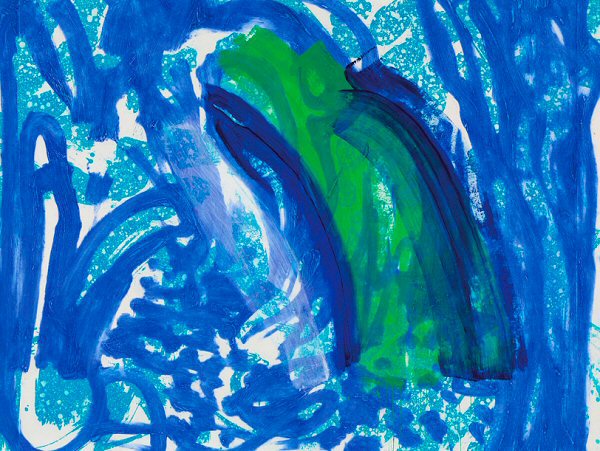 Spring (from Into the Woods) by Howard Hodgkin.
On this page
- Introduction
- Into the woods
- Spring
- Beyond the frame
- Dream woodlands
- The spirit of the woods
- Healing trees
Introduction
Art that touches the soul is rare and numinous, opening some kind of portal in the mind that transports us to another dimension. Paintings that speak volumes often defy verbal description but, like dreams, these numinous visual experiences can stay with us all our lives: tugging persistently at our curiosity, insisting on reflection and reconnection with the initial wonder.
The more I gaze at, absorb and analyze a captivating image, the more I see in it and understand about it, and the more I realize there is to be seen. The more I wonder about its numinous effect, the more I discover about myself personally, culturally, collectively and spiritually.
Into the woods
A while back now, on the basis of a small color reproduction in the Tate magazine, I journeyed to the Alan Cristea Gallery in London’s Cork Street to see a new print collection by Howard Hodgkin. Into the Woods is a series of four large abstract prints, one for each season. I have always loved Hodgkin’s work–he is an exhilarating colorist–but I was not prepared for the impact that hit me when I walked through the door and saw Spring in front of me.
Hot on the heels of amazement, reeling from the impact of the vibrant color and trying to catch my breath, I began to think: Why?
What is it that is so special about this image? Why do I want to bask in front of it endlessly? Did the artist hope or mean to touch me so profoundly? He seems to have captured a moment. Is it about spring or a symbolic personal experience? Do we share a moment in time or does this represent something out of time? Is it simply my own meaning which I invest in transference or is there something more collective and archetypal going on here?’
The print is enormous: two by three meters, an etched base in two halves swirling with turquoise aquatint and hand painted in vibrant blues with a single large arching shape in greens the color of new beech leaves. Its size is impressive, the colors, typical of Hodgkin, are clear and pure, and the abstract exuberance of the picture is, to me, thoroughly uplifting. Why?
Perhaps the way to explore this phenomenon is to tread a path down through the personal to the collective.
Spring
Beginning with a personal response to this image, first of all there is color. Certain colors seem to resonate and tune in with something deep inside me. I will stand for ages gazing at the greens of young beech woods, the blues and turquoises of summer seas and skies and the intense velvet-rich blues and purples of stained glass windows.
That rainbow of light running from yellow-green through aquamarine and cornflower blue to violet, the colors Hodgkin uses in Spring’ are all colors that I find exquisitely beautiful. Were they the first colors I saw in my mother’s eyes? Is it a co-incidence my grandmother wore colors that matched her name, Violet? Is it relevant that I was born in springtime? Are there deeper reasons why I should love these watery, airy colors but shun earthy brown or fiery reds that some others prefer?
This painting, however, is a more complex creation than random brushstrokes of color. What else might be contributing?
Perhaps the image triggers memory. When I was three years old, my father took a job as a medical locum for six months in Suffolk. We left our fourth-floor flat in St Thomas’ Street near Guy’s Hospital, where the pram had been chained to the radiator on the ground floor, and drove out of the grey London Bridge drizzle into the countryside.
The memory of these few country months shines like a ray of sunshine through my childhood. The birds sang, my mother sang. The world was wonderful. I began to find myself and express my emotions freely, which included scribbling my fury at my younger brother’s birth in red lipstick over a Peter Rabbit book, pinching the cherries off my father’s birthday cake and upending the wastepaper basket over the head of the rather posh landlady who came for tea.
There was a huge garden and I was free to explore on my own. One sunny morning I wandered much further than I had ever been before: over the lawn, past the hazel trees, the orchard and the vegetable garden, down paths wet with dew, right down to the furthest corner. There I stumbled upon a wild part of the garden that had been left to nature. I remember standing still, stunned with surprise. There, waiting quietly all this time, waiting, it seemed, just for me to discover it, was a little wood full of bluebells.
Dappled sunlight, a breeze ruffling the limp leaves, the odd chirrup of a bird I couldn’t yet name, the fresh scent of bluebells, the marvelous color–all of this was important–but what really mattered was that I had found the wood all by myself and I felt that the wood had been waiting all its life for me to discover it.
I did not, like Alice, fall down a rabbit hole, but it felt as momentous. I recognized I was alone in the presence of something very special. I had no words, being so little, to describe my feelings, but a connection with something far bigger than myself was established and I knew even then that it was a secret experience I would remember all my life.
Perhaps it was my first conscious encounter with the Self.
Standing before Hodgkin’s painting, I was at once both the adult gazing at the picture in the gallery and the three-year-old entranced by the bluebell wood. There was, however, another memorable experience that the picture conjured up, this time from my early twenties.
One day, in the days before satnav, while exploring an Ordnance Survey map of the south Devon coast, I noticed an unexplored track going down to the sea that intrigued me. Devon lanes are dug deep into the fields, flanked on either side by steep hedges bristling with ferns. Without a map it’s easy to get lost, but eventually we squeezed down the bumpy single-track descent to Lannacombe. It was late April.
Winding down a lane where the branches of the trees met overhead, a stream trickling by on one side and a wood full of bluebells in full bloom on the other, we found ourselves negotiating a cracked tarmac road with a central column of grass and weeds that in turn became a rough stony track, eventually leading to a small deserted sandy beach.
It felt like a sacred journey: a mirror of an internal quest encountering a new yet very ancient world of meaning.
Perhaps the great green arch in Hodgkin’s picture reminded me of the way to the sea, of the passage of birth, or of death. Perhaps it reminded me of the soaring columns of Notre Dame. And perhaps this symbolic journey was, as T. S. Eliot describes in the Four Quartets, a moment when we “arrive where we started and know the place for the first time” (Eliot, 1959).
In an Infant Observation group, we heard about the way one particular mother revealed the world to her baby. On many occasions she held him in her arms and showed him the brightly colored feathers on a mobile, naming all the colors one by one and making them dance in the air. Her son watched wide-eyed, in wonder, as if each encounter was the first. Might he retain the capacity to be amazed, as he grows up? Might the pleasant surprises in his life be tinged with an original memory of being held in arms, and being introduced to the beauty and wonder of the world?
My grandmother, Violet, revealed the secrets of the natural world to me. She showed me how to look under damp leaves for wild strawberries, how to see rain streaking the horizon, how to tell the weather from the clouds and recognize birdsong. Perhaps, like the baby in the Infant Observation group, we retain the capacity to be constantly delighted by moments of (re)discovery.
Perhaps our psyche needs the balancing reminder of eternal spring when faced with the dark deaths of nigredo.
Our seasons and our lives follow the cycle of death and rebirth, but the process of individuation is not circular, it is spiral. We can seem to be utterly blighted by vicious cruelty, but springtime itself and the creativity of artists who capture wonder and beauty are the constant reminder of new and eternal growth, even if sometimes it seems outrageous that the sun should dare to rise.
Spring is the youngest of the revolving seasons. With the return of the light, the lengthening of the days, and the rise of the sap, we are annually reminded, as green shoots burst from sleeping branches, of the ephemeral movement of time and the eternal cyclic death and rebirth that patterns our year.
The seasons shape our lifetime. Spring symbolizes an emergence of fertile and creative consciousness.
It seems to me that Howard Hodgkin’s Spring captures an essence of discovery, or echoing T. S. Eliot: a re-discovery. The painting, like the bluebell wood and the lane down to Lannacombe, sparks the thrill of the best mornings, when we wake up to something that has been waiting to be found, and we see the world with new eyes.
Do we create this world? Does the Self have an innate expectation of searching and finding?
Beyond the frame
Howard Hodgkin’s Spring is one of the four seasons from the Into the Woods series, and the fact that his inspiration comes from woods is important. Jung wrote the following about trees:
A tree is one of the best examples of a motif that appears in dreams (and elsewhere) that can have an incredible variety of meanings. It might symbolize evolution, physical growth, or psychological maturation; it might symbolise sacrifice or death (Christ’s crucifixion on the tree); it might be a phallic symbol; it might be a great deal more. (Jung, 1964)
By way of a seventieth birthday celebration for the professor of Botany at Basel University, Jung wrote an extensive paper about the symbol of the tree (Jung 1968). He explored the archetypal image with reference to thirty-two of his patients’ spontaneous paintings and discussed the imagery in each individual picture before expanding on eighteen separate aspects of the symbol of the tree.
Jung knew that delving into the archetypes could be tricky: all archetypes in the unconscious are contaminated with each other. Marie-Louise von Franz described it this way:
I am always reminded of the Chinese who speak of a certain kind of grass whose roots spread so far that you never get it all up. The Chinese say that if you pull up a root of this grass the whole lawn comes with it! It is the same with the archetypes, if you pull at one of them long enough the whole collective unconscious follows! (von Franz, 1978)
Dream woodlands
Two other artworks amplify a pivotal dream that changed the course of my life.
One painting depicts a sunny path through friendly deciduous woodland, the other, more ominously, portrays silent trunks of tall pine trees on the fringes of a deep dark Norfolk forest. At this point in my life, I had decided to train as a therapist but had decided on a course that would not have taken me into analysis. But something in me had other ideas.
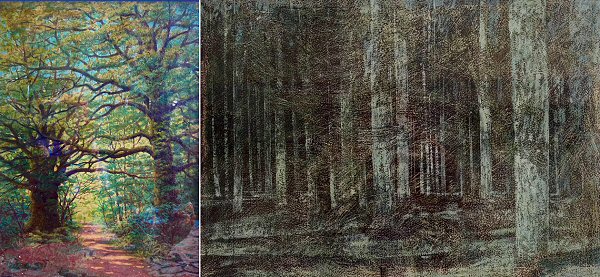 Woodland Path (artist unknown, left); Norfolk Forest by Ann Kilvington (right).
I dreamt that I was walking with a male friend (a pediatric anesthetist) along a well-trodden path through a sunny oak wood. As we walked, I noticed we were passing, on my left, the tall trunks of a silent coniferous forest where the needles carpeted the floor. No path was visible and there was only deepening darkness to be seen through the trees. We stopped and looked into the conifers. Then, touching my arm and pointing to the sunny track ahead, my animus figure said: “You don’t have to go this way, you know”.
The next day, with my heart in my throat, I began looking for an analyst.
The dream describes two ways through the woodlands and forests of the psyche. I was faced with the choice between the sunny path I thought I had decided upon and the dark uncertainty of the unexplored.
The two images represent two poles of an archetypal symbol that is crucially different from those vertical descents that take us down into the unconscious of the underworld or the sea.
Woods are inextricably linked with the archetype of the way. They represent the shadowy landscapes of our wilder psychic borderlands where we walk through vegetation, in touch with the earth’s crust and the anima mundi.
Need or curiosity leads us away from the familiar world, where we might expect the unexpected to be lurking. Is there evidence of cultural, collective and spiritual meaning in the archetypal images of Into the Woods?
A sun-sprinkled broad-leaved woodland invites us in to chase butterflies, birds, and deer, and gather ripe strawberries. It lays out seductive, well-trodden paths that typify the benevolent daytime aspect of this archetypal image.
In fairy tales and mythology, however, the path of heroes and heroines usually involves getting lost, often in the woods. In the deeper and darkening gloom, farther and farther from tamed and cultivated homelands, the forest becomes menacing. It becomes the terrifying domain of gnomes, trolls, wolves and witches.
If you ever saw Walt Disney‘s cartoon film Snow White and the Seven Dwarves, you may remember how the friendly daytime trees, which had been filled with scampering animals and chattering birds, took on demonic monstrous features as color and light fled from the wood.
Lost in the deep dark wood, far from the familiar areas of the personal psyche that border consciousness, we find ourselves revisiting the wild, making our own new solitary path in uncharted unconscious territory. We can’t go back, and we don’t know where we are going. We only know that there is a journey to be taken to encounter our Self and it must be undertaken.
Where there is a forest or a wood and a human psyche there is an archetype of the Way. Mircea Eliade wrote about the difficulty of the path to the center:
The road is arduous, fraught with perils, because it is, in fact, a rite of passage from the profane to the sacred, from the ephemeral and illusory to reality and eternity, from death to life, from man to the divinity. Attaining the centre is equivalent to a consecration, an initiation… (Eliade, 1954, p. 18)
The journey through the maze of the forest is symbolic of individuation, the search for Self. In order to develop, we must encounter the dark side of our psyche and the monsters of our past and present:
- the terrible devouring witch mother (Hansel and Gretel),
- the wolf disguised in Grandmother’s clothing (Little Red Riding Hood),
- the three bears (Goldilocks).
We must hack though thorny thickets to wake the beautiful enchanted princess and her court (The Sleeping Beauty) or travel through the fur coats in the back of the wardrobe to discover a timeless forest frozen in eternal icy winter (e.g. The Lion, The Witch and The Wardrobe).
The mystery of the forest still grips contemporary culture (e.g. The Blair Witch Project, 1999).
Bruno Bettelheim sees the adventure into the woods as re-visiting the “the all-good mother of infancy and the all-bad mother of the oedipal crisis.” (Bettelheim, 1976).
From a Jungian perspective, this journey is not only regressive, but also has the teleological purpose of seeking new wisdom, and developing a Self that strives for wholeness.
While single trees can be phallic or maternal, woods are sacred female places. Clarissa Pinkola Estes writes eloquently about the archetype of the Wild Woman and female individuation with reference to the myth of The Handless Maiden (Pinkola Estes, 1992). The myth symbolizes the painful process of physical, psychological and spiritual growth that transforms an innocent girl into a wise woman. The important aspect of the myth concerns endurance, both in terms of gritty survival and building resilience as the tale takes us repeatedly in and out of the woods.
In this fairy tale, woods are where the Devil emerges to wreck our heroine’s uncomplicated existence.
The forest is also the foreign terrain that she must traverse alone in agony with dismembered arms, becoming increasingly dirty, hungry and disheveled. At the wood’s heart she finds a royal orchard surrounded by a moat, where the kind pear trees lower their fruits in the moonlight, and where she is spied by the king, who makes her silver hands and marries her.
However, the trials are not over. The jealous Devil who has been deprived of his prize, falsifies messages from the king, who is away at war. The messages instruct his mother to kill the young queen and her son, but the mother cannot carry out the murder and our heroine flees with her child once more into the deep forest. She eventually finds sanctuary in the care of an inn run by the wise people of the woods.
After discovering the Devil’s deceit, the king searches the world for seven long years, finally stumbling upon the inn in the forest, and his queen with her hands fully regrown. The two are reunited in a second wedding and, as in all the best fairytales, live happily ever after.
The domain of the Devil also holds, at its heart, a sacred place of nourishment, healing and creative (re)union.
The spirit of the woods
Perhaps we should not be surprised that woods play such an important symbolic part in our collective objective psyche. We count tree rings that measure the years and realize that some have stood as silent witness to our human comings and goings for generations. They send their roots deep into the earth and raise their arms, alive with birds, bees and squirrels, high to the heavens.
Many die in autumn to be reborn in spring, providing shelter, food, warmth, medicine, oxygen and shelter. They catch the wind, moan, creak and rustle, and communicate with each other through an underground mycelial network.
Western Europe was once swathed in immense forests of chestnut, oak and elm. J. G. Frazer describes reports of travelers in Roman times who journeyed for two months solid through forests without reaching an end (Frazer, 1922). In southern England, the great wood of Anderida spread throughout Kent, Surrey and Sussex while another vast forest stretched westwards from Hampshire to Devon. In the reign of Henry II, bull and boar were hunted in the wild woods of Hampstead.
These enormous woods are now fragments of their former selves, but perhaps it is a different matter in our inner landscape. Maybe endless forests still flourish in our psyche.
Being the source of food, shelter and warmth, trees and woodlands were sacred in numerous European religions. Tree worship was prominent in Lithuania until the fourteenth century. The ancient Teutonic, Celtic and Latin words for temple and sanctuary come from words for a grove or woodland glade. The words for tree and truth share the same etymological root.
Once upon a time, trees were not symbols but animated spirits. Individual trees had souls, magical powers, wisdom and mystical oracular voices.
An old Greek myth tells us that in the beginning of time, Zeus married Chthonia, the earth goddess, and created the world by weaving a huge mantle, which he spread over an oak tree (von Franz, 1978).
According to the Book of Genesis in the Bible, in the beginning Adam and Eve lived in a naive paradise. (The Greek word paradeisos means an enclosed garden or park.)
The Tree of Life, a familiar mythological motif in many art forms, recalls the Garden of Eden. It is an archetypal image going back to the Canaanite culture of the 10th–9th millennium BCE. The Tree of Life is a bilaterally symmetrical design: a tall straight trunk from which branches spring and through which pairs of birds might swoop or roost among the leaves and flowers. The fact that human hands have re-created beautiful images of the Tree of Life mediates and makes the numinous archetypal symbolism visible.
Over time, collective consciousness may shift; religious cultures may evolve. Trees may seem to lose their magical powers and become instead the places where mythical people live: nymphs, satyrs, diviners and priestesses.
Diana/Artemis becomes the goddess of the forest and fertility, with dominion over woodland, groves, hills and streams, wild beasts, as well as the moon and childbirth. Christ becomes the Tree of Life and the Way. Trees lose their spirits, but maybe the old spirit of place, the genius loci, lives on.
When we withdraw our projections, James Hillman writes, we cease to hear the wisdom of the voice of nature. He questions our use of the word projection, and with his imaginal view, looks from the perspective of archetypal psychology:
[…] we realise that what psychology has had to call projection is simply animation, as this thing or that spontaneously comes alive, arrests our attention, draws us to it. […]Of course things are dead, said the old psychology, because they do not experience (feelings, memories, intentions). […]
Not only does this view kill things by viewing them as dead; it imprisons us in that tight little cell of ego. (Hillman, 1982)
In his study on mysticism, F. C. Happold includes a chapter on Nature-mysticism and Soul-mysticism with extracts from Richard Jefferies’ last piece of writing The Story of my Heart (Happold, 1963). Jefferies’ poetic description of mystical experience attempts to put into words something “additional to the existence of the soul; […] additional to immortality; and beyond the idea of deity”.
He describes, essentially, a walk up a hill, lying down on the grass in the sun, and returning. But the profound experience waiting for him on the chalky downland took him into the heart and soul of communion with the numinosum of the anima mundi.
For us mere mortals, glimpses of the ineffable Self are hard to describe, but we may grasp at threads spun from music, poetry or art.
Healing trees
The healing power of trees has a particular link with the analytical psychology we practice today. We use the term transference to describe a form of projection whereby we carry an aspect of our patient’s psyche.
Transference has its origins in the ritual of transferring sickness from a human being to a tree. An invalid in Karpathos in Greece would wear a red thread around their neck overnight (in Italy it was the left wrist), removing it in the morning and tying it on the branch of a sacred tree, which would then take on the ailment.
A Flemish version involved tying a willow branch in a knot. In Cheshire there is still an idea that if you rub your warts with bacon and slip it under the bark of an ash tree, you will be cured while the ash tree grows warty protrusions.
Hodgkin’s Spring now sits behind me as I work online. It is my faithful, silent, sustaining backdrop and companion, as day in, day out, year in, year out, seasons come and seasons go. The woodland on my wall witnesses, along with me, the broken minds and vandalized hearts of souls that seem sometimes utterly cauterized, yet hope for spring.
It acts as a reminder that you are bound to find more than you bargained for if you go into the woods, and that treasures as well as monsters live there.
May 2026
References
View references cited in this article
Bettelheim, B. (1976). The uses of enchantment. Thames & Hudson.
Eliot, T. S. (1959). Four quartets. Faber and Faber.
Frazer, J. G. (1922). The golden bough. Macmillan.
Happold, F. C. (1963). Mysticism. Penguin.
Hillman, J. (1982). Anima mundi: The return of the soul to the world. Spring.
Jung, C. G. (1964). Man and his symbols. Aldous.
Jung, C. G. (1968). Alchemical studies. CW 13.
Pinkola Estes, C. (1992). Women who run with the wolves. Rider.
von Franz, M.-L. (1978). Creation myths. Spring.
 Marilyn Mathew
Marilyn A F Mathew is a Jungian Training & Supervising Analyst for the British Jungian Analytic Association (BJAA/bpf) and a member of the IAAP. She qualified in 1994 and since then has taken the role of Chair of the BJAA and Chair of the BJAA Training Committee.
She is an experienced Social Dreaming Matrix Convener and is highly interested in all aspects of dreaming, as well as unconscious and non-verbal communication, infant observation, and the relationship of psyche with soma.
She is the author of a number of published papers and book chapters and was the first to win the British Association of Psychotherapists’ award for a final Infant Observation paper.
Article